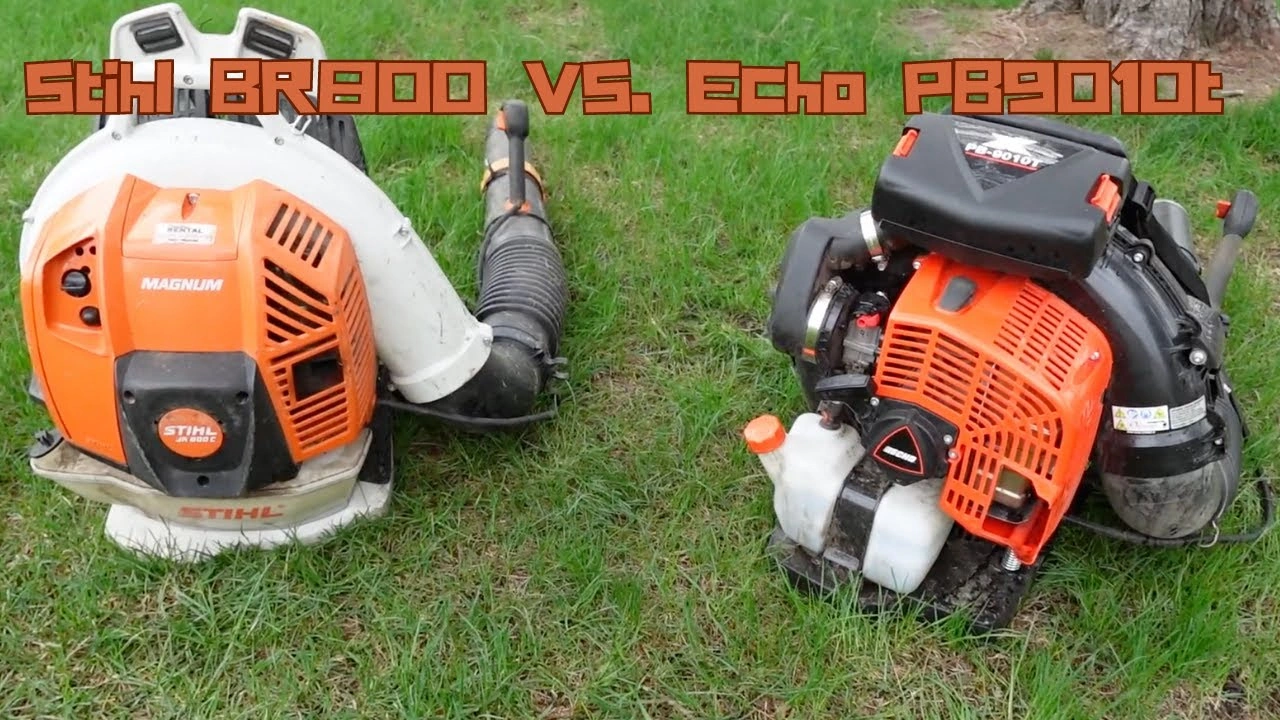
The main difference between Echo and Stihl leaf blowers is performance focus. Echo leaf blowers typically deliver higher CFM and better value, making them ideal for moving large volumes of dry leaves. Stihl leaf blowers prioritize lighter weight, comfort, and long-term reliability, often performing better with wet leaves and extended professional use. Neither brand is universally better; the choice depends on power versus control.
Power and Airflow Performance
Raw power stands as the defining factor in determining which is better, the Echo or the Stihl leaf blower. Let’s examine the performance metrics that set these two giants apart.
Engine Size: 79.9cc (Echo PB9010T) vs 79.9cc (Stihl BR 800)
Although both the Echo PB9010T and Stihl BR 800 sport identical 79.9cc engines, their performance characteristics differ significantly. The Echo delivers raw, aggressive power that feels unleashed, whereas the Stihl delivers smoother, more controlled power. This distinction becomes apparent during extended use, with the Echo feeling like it has more brute force despite the identical displacement.
Air Volume: 1110 CFM vs 912 CFM
The Echo PB9010T dominates in air volume, pushing an impressive 1110 CFM compared to Stihl’s 912 CFM. This substantial difference of nearly 200 CFM gives the Echo a clear advantage when clearing large areas or moving substantial leaf piles. During side-by-side testing, the Echo demonstrably moved larger volumes of material per pass thanks to this superior air movement.
Air Speed: 220 MPH vs 239 MPH
Conversely, the Stihl BR 800 leads in air speed, reaching 239 MPH, compared to Echo’s 220 MPH. This higher velocity translates to more focused blasting power, particularly useful for stubborn debris or tight corners. Nevertheless, the Echo’s combination of decent speed with superior volume creates excellent overall performance in most conditions.
Dry vs Wet Leaf Blowing Efficiency
For tackling wet leaves—arguably the most challenging task for any blower—the Echo PB9010T completed the job in fewer passes. Its massive tube and higher CFM make it particularly effective for moving large piles of dry leaves.
The Stihl, despite requiring more passes for wet material, offers advantages through its more concentrated airflow pattern. Field tests confirm that the Echo finishes clearing jobs faster overall, though some professionals note that Stihl’s narrower tube might perform better in specific wet-leaf scenarios.
Generally, if moving massive volumes of dry leaves is your primary concern, the Echo’s superior CFM makes it the better choice. For wet leaves, compact debris, or precision work, the Stihl’s higher MPH offers focused power that some users prefer.
Comfort and Ergonomics
Comfort becomes the deciding factor for professionals using Echo vs stihl backpack blower models throughout lengthy workdays. Let’s examine how these competitors stack up ergonomically.
Weight: 26.7 lbs vs 23.1 lbs
The Echo PB9010T tips the scales at approximately 26.7 pounds (nearly 30 with fuel), markedly heavier than the Stihl BR 800’s 23.1 pounds. This 3.6-pound difference becomes noticeable after extended use, with many operators reporting shoulder fatigue setting in faster with the Echo. Indeed, the Stihl feels noticeably lighter when strapped on, with users describing it as “like a feather in comparison”.
Back Padding and Cooling: Air-Cooled Pad vs Standard Padding
The Echo features an innovative air-cooled back pad that channels cold air up your spine while blowing, creating a refreshing sensation during hot weather operation. Alternatively, the Stihl uses standard padding without active cooling but offers better weight distribution that minimizes heat discomfort.
Strap Design: Wide Parachute Straps vs Standard Straps
Stihl’s harness system consistently earns praise for distributing weight more evenly across the shoulders and back. Furthermore, Stihl’s anti-vibration system reduces fatigue during marathon sessions. The Echo’s harness, although it features adjustable components, doesn’t distribute weight as effectively during extended operation.
Tube Length and Arm Fatigue
Regarding tube maneuverability, the Stihl BR800 demonstrates superior mobility and flexibility. Consequently, users find the Stihl’s wand easier to maneuver all day long. In contrast, the Echo’s arm feels noticeably stiffer, potentially contributing to increased arm fatigue during prolonged operation.
Design and Usability Features
Usability features ultimately separate top-tier blowers from merely powerful machines when deciding which is better, the Echo or the Stihl leaf blower.
Trigger and Handle Design: Two-Finger vs Single-Finger
Echo PB9010T features a two-finger trigger design that comfortably accommodates both fingers. Stihl’s control system integrates the throttle trigger and setting lever directly into the steering handle. Most users report that Stihl’s handle design feels more natural in the hand. After extended operation, Stihl’s grip reduces cramping noticeably, especially when navigating uneven terrain.
Primer Bulb Placement: Rear vs Front Access
The Echo’s primer bulb is awkwardly placed, requiring users to bend down to locate and push it. In contrast, Stihl positioned its primer bulb prominently on the front of the case, where it remains clearly visible and easily accessible. This thoughtful design element saves valuable time during startup procedures.
Tube Adjustability and Control
Both Echo and STIHL models feature fully adjustable tubes, making them evenly matched in this category. Yet Stihl’s tube demonstrates superior maneuverability, with users noting it’s “a lot easier to maneuver” compared to Echo’s “stiffer arm”. This difference becomes significant during precision work around flower beds or tight spaces.
Ease of Cold Start: 1-2 Pulls for Both
Both machines demonstrate impressive starting reliability, typically requiring just 1-2 pulls to start. Stihl incorporates a purge pump primer that prevents engine flooding by limiting carburetor priming. Unlike STIHL, Echo lacks specific protection against accidental flooding.
Price and Application Fit
Beyond performance specifications and handling comfort, budget considerations and practical applications should drive your Echo vs STIHL blower decision.
Retail Price: $600 (Echo) vs $650 (Stihl)
The Echo PB9010T is slightly less expensive at $600, compared to the Stihl BR800’s $650 price tag. Although the Echo offers a modest $50 savings, many professionals consider the Stihl worth the premium for its balance and endurance. First-time buyers should note that both represent significant investments compared to mid-range models.
Best Use Cases: Mulch Beds vs Open Fields
The Echo PB9010T excels in mulch beds and areas requiring higher air volume, where its impressive 1110 CFM effectively moves material across wider areas per pass. Alternatively, the Stihl BR800 performs better in open fields, where its 239 MPH airspeed tackles stubborn debris patches more effectively. For commercial operations handling wet leaves or large piles, the Echo’s superior CFM provides a meaningful advantage.
Durability and Long-Term Use
The Stihl BR800 occasionally experiences choke issues on cold starts after idle periods, requiring carburetor cleaning. In contrast, the Echo PB9010T sometimes exhibits throttle lag under load, which can be corrected by adjusting the cable. Both machines demand routine maintenance to maintain optimal performance.
Which Blower Fits Your Business Needs?
For landscapers managing properties with extensive mulch beds or tree cover, the Echo’s raw power justifies its investment. For weekend warriors who prioritize longevity and torque, the Stihl offers better balance for the long haul. Ultimately, the Echo PB9010T represents the top choice for 33% of surveyed lawn care professionals.
Comparison Table
| Feature | Echo PB9010T | Stihl BR 800 |
|---|---|---|
| Technical Specifications | ||
| Engine Size | 79.9cc | 79.9cc |
| Weight | 26.7 lbs | 23.1 lbs |
| Retail Price | $600 | $650 |
| Performance Metrics | ||
| Air Volume | 1110 CFM | 912 CFM |
| Air Speed | 220 MPH | 239 MPH |
| Power Delivery | Raw, aggressive power | Smoother, controlled delivery |
| Ergonomics | ||
| Back Padding | Air-cooled pad | Standard padding |
| Strap Design | Wide parachute straps | Standard straps with better weight distribution |
| Tube Maneuverability | Stiffer arm | Superior mobility and flexibility |
| Features | ||
| Trigger Design | Two-finger trigger | Single-finger integrated control |
| Primer Bulb Location | Rear access (awkward) | Front access (easily accessible) |
| Cold Start | 1-2 pulls | 1-2 pulls |
| Best Applications | ||
| Ideal Use Case | Mulch beds, large volume areas | Open fields, precision work |
| Wet Leaf Performance | Better efficiency, fewer passes | Requires more passes |
| Strength | Superior volume movement | Focused blasting power |
Conclusion
After thoroughly examining both manufacturers’ top models, the answer to which is better, the Echo or the STIHL leaf blower, ultimately depends on your specific needs. Both brands offer exceptional quality, though they excel in different areas.
The Echo PB9010T clearly dominates in raw air volume, with its impressive 1110 CFM, making it particularly effective for quickly clearing large areas. Meanwhile, the Stihl BR800 counters with superior air speed at 239 MPH, providing more focused blasting power for stubborn debris. Additionally, the Stihl wins the comfort battle with its lighter weight (23.1 lbs vs Echo’s 26.7 lbs) and better weight distribution system.
Ergonomics certainly plays a crucial role in this comparison. The Echo offers a unique air-cooled back pad that keeps operators comfortable during hot weather, whereas the Stihl provides a more naturally comfortable grip that reduces hand fatigue during extended use. Undoubtedly, these features become increasingly important during all-day professional use.