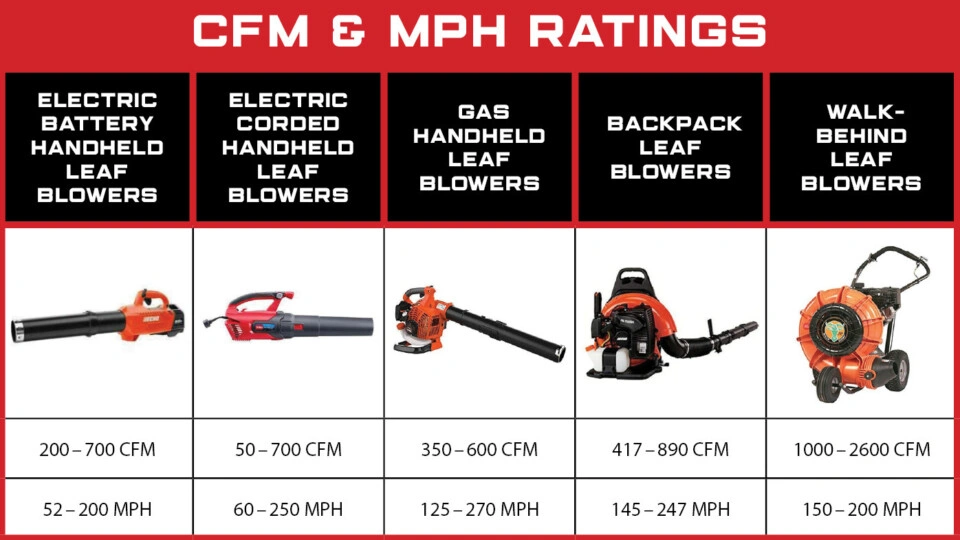
CFM in a leaf blower means Cubic Feet per Minute. It measures the volume of air the blower moves. Higher CFM clears more leaves and debris at once, making it ideal for large yards and heavy leaf buildup. Strong leaf blowers balance high CFM for coverage with high MPH for force.
What does CFM mean on a leaf blower?
When shopping for a leaf blower, you’ll notice mysterious numbers on the packaging. Understanding these specifications makes all the difference in finding the right tool for your yard.
Definition of CFM in simple terms
CFM measures the volume of air a leaf blower can move. Think of it as the “how much” factor that determines the space you can clear. It’s essentially the amount of air being pushed through the blower’s nozzle during one minute of operation.
To visualize this concept, imagine using a 100 CFM leaf blower to fill a giant balloon. In one minute, you could inflate that balloon to about 5 feet, 9 inches tall. The higher the CFM value, the more air your leaf blower produces, allowing you to clear wider areas in less time.
What does CFM stand for in leaf blowers?
CFM stands for Cubic Feet per Minute. This terminology isn’t unique to leaf blowers – fans and air compressors use this measurement too. In the context of leaf blowers, it represents the quantity of air being pulled in and pushed out through the blower over the course of sixty seconds.
A leaf blower with higher CFM means greater efficiency in moving debris. Consider these typical ranges:
- Low CFM (100-300): Suitable for light-duty tasks like cleaning small gardens
- Medium CFM (300-500): Ideal for moderate jobs such as clearing dry leaves from yards
- High CFM (500+): Best for professional use, handling wet leaves, and large areas
How CFM is measured
CFM is measured using an instrument called an anemometer. This device calculates the volume of air moving through the blower in one minute. Manufacturers test their blowers under controlled conditions to determine these ratings.
The measurement directly correlates to the blower’s effectiveness – higher CFM equals more debris moved. Furthermore, a blower with substantial CFM can handle larger volumes of debris more efficiently, making yard cleanup quicker and less laborious.
Unlike some specifications that might seem abstract, CFM translates directly to real-world performance. Additionally, different debris types require varying air volumes – for instance, wet leaves may necessitate a higher CFM compared to dry ones.
How CFM affects leaf blower performance
First and foremost, understanding how CFM affects your leaf blower’s performance helps you make better decisions about which model to purchase for your specific needs.
Volume of air moved per minute
The CFM rating directly represents how much air a blower can push in sixty seconds. This “push” or “muscle” behind the blower determines its cleaning power. In practical terms, a higher CFM rating means your leaf blower produces more air, allowing you to clean a larger area in less time. It’s similar to using a wider broom that helps you push more leaves in one sweep.
Impact on clearing large areas
The efficiency of a leaf blower in clearing large spaces depends significantly on its CFM rating. A blower with high CFM helps you move more leaves and easily clear bigger spaces in less time. For residential use, models with at least 400 CFM are recommended for effective clearing. When dealing with substantial properties, the time-saving benefit becomes even more apparent—a leaf blower with 400-700 CFM is ideal for clearing half an acre of land.
Why higher CFM is better for dry leaves
For tackling piles of dry leaves, CFM matters more than speed. High CFM units move large air volumes at relatively low speeds, allowing large areas to be swept and cleared in a controlled, shorter time. Because of this, when you need to blow huge piles of leaves across large landscaping areas, choosing a higher CFM option is more effective.
Consider this practical example: a high CFM (around 600) with lower MPH (about 120) blower moves a lot of leaves at once, making it perfect for sweeping dry leaves across a big lawn. In contrast to wet or heavy debris that might require more force, dry leaves respond particularly well to volume rather than speed.
Therefore, a leaf blower with substantial CFM can handle larger volumes of debris more efficiently, making your yard cleanup quicker and less laborious.
CFM vs MPH: What’s the difference?
As a homeowner looking at leaf blower specs, I’ve noticed two measurements constantly competing for attention: CFM and MPH. Understanding the distinction between these metrics helps make smarter purchasing decisions.
What is MPH and how it compares to CFM
MPH (Miles Per Hour) measures the speed of air coming out of the blower’s nozzle. Specifically, it tells you how fast the air travels when exiting the machine.
Whereas CFM measures volume (how much air moves), MPH indicates force or intensity (how fast that air moves). Think of it this way: CFM is like the width of water flowing through a hose, while MPH is the pressure behind that water.
When to prioritize CFM over MPH
I’ve found that CFM becomes more important when:
- Clearing large areas of light debris like dry leaves
- Moving piles across wider spaces
- Working with scattered debris across the lawn
For residential yards with lots of space to cover, a higher CFM generally provides more efficient cleanup since it moves more material with each pass.
When MPH matters more than CFM
Conversely, MPH becomes the critical factor when:
- Dislodging wet, stuck-on debris
- Removing embedded dirt from cracks or crevices
- Dealing with heavier materials like pine needles
The concentrated air stream from high-MPH blowers excels at breaking stubborn debris loose from surfaces.
What is the difference between CFM and MPH on a leaf blower?
Simply put, CFM determines area coverage (width of clearing), whereas MPH determines blowing power (force of air). Together, these measurements tell the complete story of a blower’s capabilities.
For most home landscaping tasks, finding a balanced combination yields the best results. A blower with moderate-to-high CFM (400-600) and decent MPH (150-190) typically handles most residential yard cleanup effectively.
How to choose the right CFM for your yard
Selecting the appropriate leaf blower starts with matching CFM to your yard size. After considering what CFM means, let’s examine how much blowing power you actually need.
Small yards: 200–400 CFM
For patios, balconies, and yards under 2,000 square feet, a leaf blower with 150-400 CFM provides sufficient power. These lightweight models (typically under 7 pounds) easily handle dry leaves and light debris. Corded electric or small battery-powered handheld blowers work perfectly for these compact spaces.
Medium yards: 400–600 CFM
Properties between 2,000-5,000 square feet benefit from 400-600 CFM blowers. This range efficiently manages seasonal cleanup, pine needles, and moderate leaf coverage. A 400 CFM blower performs excellently for a half-acre lot, making it ideal for suburban homes.
Large yards: 600+ CFM
Yards exceeding 5,000 square feet require blowers with 600+ CFM capacity. These powerful units efficiently clear heavy, wet leaves, sticks, and even acorns. Property owners with 1+ acres often prefer models around 650 CFM for maximum efficiency.
Other factors: nozzle size, blower type, and power source
Apart from CFM, consider nozzle design—wider nozzles move more leaves, while rounded ones better handle heavier debris. Moreover, evaluate your comfort with different types (handheld vs. backpack). Lastly, assess power source options—gas provides maximum power but battery models offer quieter operation with decreasing performance tradeoffs.
Conclusion
Understanding CFM undoubtedly makes a significant difference when shopping for the perfect leaf blower. After exploring what this measurement means, we now see how crucial it becomes for efficient yard maintenance. CFM directly impacts your blower’s ability to clear large areas quickly, especially when dealing with dry leaves and light debris.
Most homeowners will find a leaf blower with 400-700 CFM sufficient for typical residential needs. However, your specific yard size ultimately determines the ideal CFM range. Small yards need only 200-400 CFM, medium yards benefit from 400-600 CFM, while large properties require 600+ CFM for optimal performance.
Though MPH measures air speed rather than volume, both specifications work together to determine overall effectiveness. CFM handles quantity of debris, while MPH tackles stubborn, wet materials. This balance means you should consider both measurements when making your purchase decision.