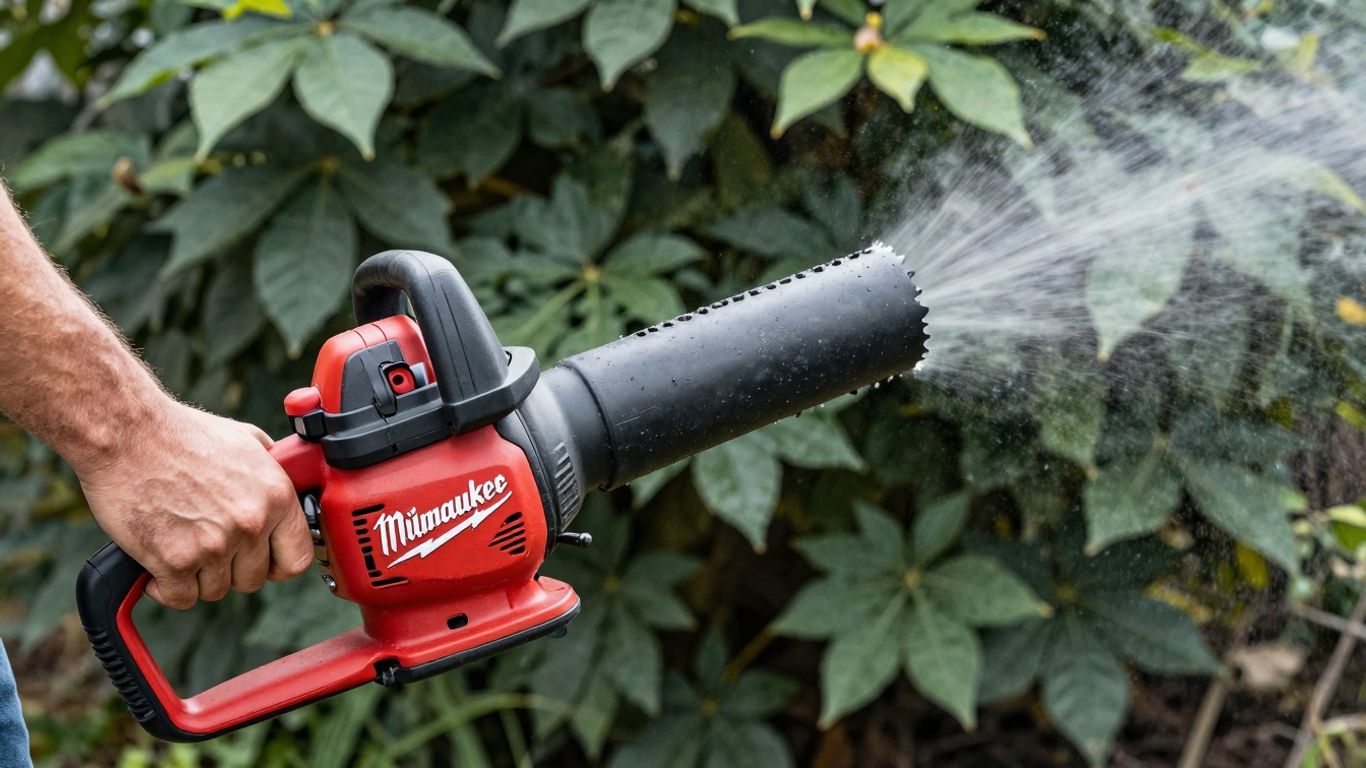
The main difference between CFM and MPH in a leaf blower is function. CFM moves air volume and clears large areas of light debris. MPH delivers air speed and removes heavy or wet leaves. The best leaf blower combines high CFM and high MPH for balanced, powerful performance.
What is the difference between CFM and MPH on a leaf blower?
Understanding the specifications on a leaf blower can feel like deciphering a foreign language. To make an informed purchase, you need to grasp the fundamental difference between two critical measurements: CFM and MPH.
What does CFM mean?
CFM stands for Cubic Feet per Minute and measures the volume of air a leaf blower can move in one minute. Essentially, CFM indicates how much air passes through the blower’s nozzle, determining the amount of debris you can clear at once. The higher the CFM rating, the more leaves and debris you can move simultaneously. For reference:
- Low CFM (100-300): Suitable for light-duty tasks like cleaning small areas
- Medium CFM (300-500): Effective for moderate yard work
- High CFM (500+): Ideal for professional use and large properties
What does MPH mean?
MPH, or Miles Per Hour, measures the speed of air exiting the leaf blower. Unlike CFM, which focuses on quantity, MPH indicates how fast that air travels, affecting the force behind the airflow. Higher MPH ratings provide greater power to move heavier or stubborn debris. Generally:
- Low MPH (100-150): Best for gentle tasks and delicate surfaces
- Medium MPH (150-200): Good for regular yard maintenance
- High MPH (200+): Necessary for wet leaves and compacted debris
How are they measured?
Leaf blower manufacturers typically measure CFM using an anemometer, which calculates the amount of air being pulled in and expelled through the blower. Interestingly, MPH can be manipulated based on the width of the nozzle—narrower tubes create higher MPH readings as the same air volume gets concentrated through a smaller opening. Both measurements depend on factors such as:
- Speed and length of the impeller blades
- Angle of rotation of the impeller
- Motor or engine power
Why these numbers matter
Together, CFM and MPH determine your leaf blower’s overall effectiveness. These measurements aren’t independent—they affect each other directly. As air volume (CFM) increases, maintaining high speed (MPH) becomes more difficult. Think of it like water flowing through different pipes: a larger pipe (high CFM) moves more water but with less distance, whereas a narrow straw (high MPH) shoots water farther but in smaller amounts.
The relationship between these measurements creates a practical formula: Blowing Force = (CFM × MPH / 1000), which helps determine how well a blower can actually move debris.
When is CFM more important in a leaf blower?
Having a leaf blower with high CFM (cubic feet per minute) can make all the difference in specific scenarios. Let me share when focusing on this specification will give you the best results.
Best for large areas
For homeowners with expansive yards, focusing on CFM delivers significant benefits. If you’re maintaining property larger than half an acre, look for leaf blowers with 700+ CFM to efficiently clear wide spaces. For properties spanning multiple acres, professional-grade blowers offering 800-1000+ CFM provide the volume needed to handle bigger cleanup jobs.
The correlation is straightforward—the more ground you need to cover, the higher CFM you’ll want. Consider this a primary factor when shopping for large landscapes or commercial properties where covering ground quickly matters more than pinpoint precision.
Ideal for dry leaves and light debris
High CFM leaf blowers truly shine when dealing with dry, lightweight materials. Picture moving a large volume of autumn leaves across your lawn—a blower with 600 CFM can sweep away impressive amounts even at moderate speeds around 120 MPH.
Furthermore, this specification becomes particularly valuable for:
- Breaking up and dispersing large leaf piles
- Clearing open lawn areas where precision isn’t crucial
- Moving significant amounts of debris in fewer passes
Faster cleanup with high air volume
The efficiency advantage of high CFM blowers comes from their ability to move more material with each sweep. Much like using a wider broom, a blower with substantial air volume (500+ CFM) saves time by reducing the number of passes needed.
Additionally, high-volume air movement creates a more efficient cleanup experience by:
- Helping you clear enormous piles of leaves in less time
- Reducing the need to go over the same area repeatedly
- Moving dry leaves across extensive open spaces at once
Consequently, if you regularly face large-scale cleanup tasks or maintain substantial property, prioritizing CFM gives you the volume advantage needed for efficient yard maintenance.
When is MPH more important in a leaf blower?
Air speed plays a crucial role in certain leaf blowing scenarios. When deciding what is better in a leaf blower CFM or MPH, there are specific situations where the Miles Per Hour rating deserves your attention.
Best for wet or stuck debris
When facing wet leaves or stubborn debris, a high MPH rating becomes invaluable. The faster airspeed provides the necessary force to dislodge materials that resist movement. For wet leaves stuck in grass or compacted piles, look for leaf blowers with 200+ MPH ratings.
Much like the focused tip of a broom, high MPH creates a powerful, concentrated jet of air that breaks up clumps and lifts matted-down materials. This focused force helps remove leaves stuck between pavers or along fences – situations where volume alone won’t suffice.
Useful for precision tasks
MPH shines whenever accuracy matters more than coverage area. A higher MPH gives you better control when:
- Blowing leaves out of flower beds
- Directing debris into neat piles
- Reaching into corners and tight spots
- Clearing debris from cracks and crevices
The focused stream of a high-MPH blower offers surgical precision compared to high-volume alternatives. For instance, some models even feature scraper tips specifically designed to loosen damp, matted leaves from surfaces.
Better for hard surfaces like driveways
Hard surfaces benefit tremendously from higher air velocity. When clearing patios, driveways, or sidewalks, MPH provides the lifting power needed to break the friction between debris and surface.
The speed of the air helps lift leaves and debris off pavement, propelling them exactly where you want them to go. Therefore, most residential applications benefit from leaf blowers offering between 110-200 MPH, depending on your specific cleaning needs.
Nevertheless, remember that MPH alone isn’t enough—a balanced leaf blower needs adequate CFM to maintain effectiveness across various tasks.
What’s better on a leaf blower: CFM or MPH?
After exploring individual metrics, the question remains: what is better in a leaf blower CFM or MPH? The answer isn’t straightforward—it depends on your specific needs.
How to balance both metrics
Finding the right balance between these measurements is crucial. Indeed, most homeowners benefit from a leaf blower that offers moderate to high ratings in both categories. For residential use, aim for at least 400-600 CFM coupled with 110-180 MPH. This combination delivers sufficient power for most yard maintenance tasks without sacrificing either volume or force.
Examples of high CFM vs high MPH models
Different models prioritize different strengths:
High CFM Models:
- Backpack blowers (600-900 CFM, moderate MPH)
- Commercial-grade blowers (700+ CFM)
- Best for: Large properties, professional landscaping
High MPH Models:
- Compact handheld blowers (200+ MPH, modest CFM)
- Models with concentrator nozzles
- Best for: Precision work, wet debris, hardscape cleaning
Blowing force formula: CFM x MPH / 1000
To determine overall effectiveness, multiply CFM by MPH and divide by 1,000. This calculation, known as blowing force, gives you a single number that balances both metrics. For example, a blower with 450 CFM and 190 MPH has a blowing force of 85.5—a solid rating for residential use.
Which is more important for a leaf blower: CFM or MPH?
Given these points, for most homeowners, CFM slightly edges out MPH in importance. Air volume allows you to move more debris at once, making yard cleanup faster. Still, the ideal approach is selecting a blower that provides adequate measurements in both categories rather than maximizing one at the expense of the other.
Conclusion
Choosing between CFM and MPH ultimately depends on your specific yard maintenance needs. After examining both metrics closely, CFM proves slightly more valuable for most homeowners because it determines how much debris you can move at once, making cleanup faster and more efficient. Nevertheless, the ideal leaf blower balances both specifications rather than maximizing one at the expense of the other.
Remember this simple rule: prioritize CFM for large properties with lots of dry leaves and light debris. Conversely, focus on MPH when dealing with wet, matted leaves, precision tasks, or clearing hard surfaces. Consequently, understanding your primary yard challenges before shopping will guide you toward the right choice.
The blowing force formula (CFM × MPH / 1000) offers a straightforward way to compare different models. For most residential yards, a leaf blower with 400-600 CFM and 110-180 MPH provides ample power for typical cleanup tasks. Additionally, if budget constraints force you to choose, experts generally recommend leaning toward higher CFM ratings for overall efficiency.