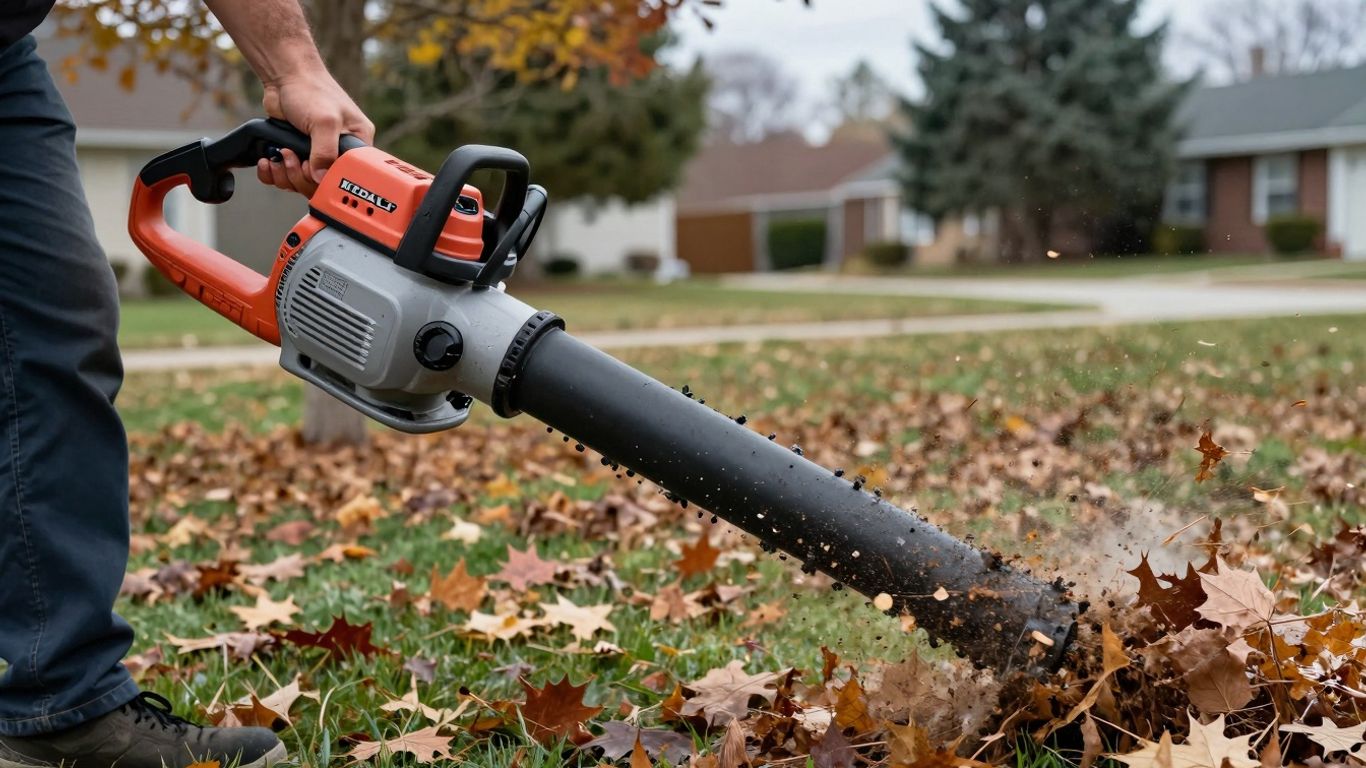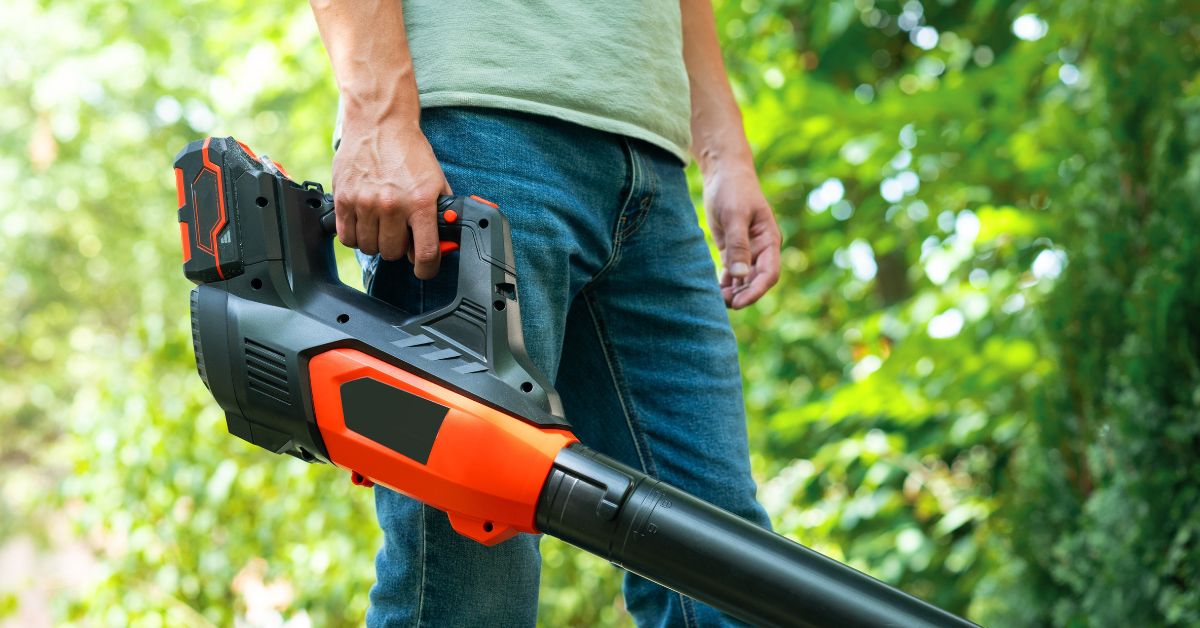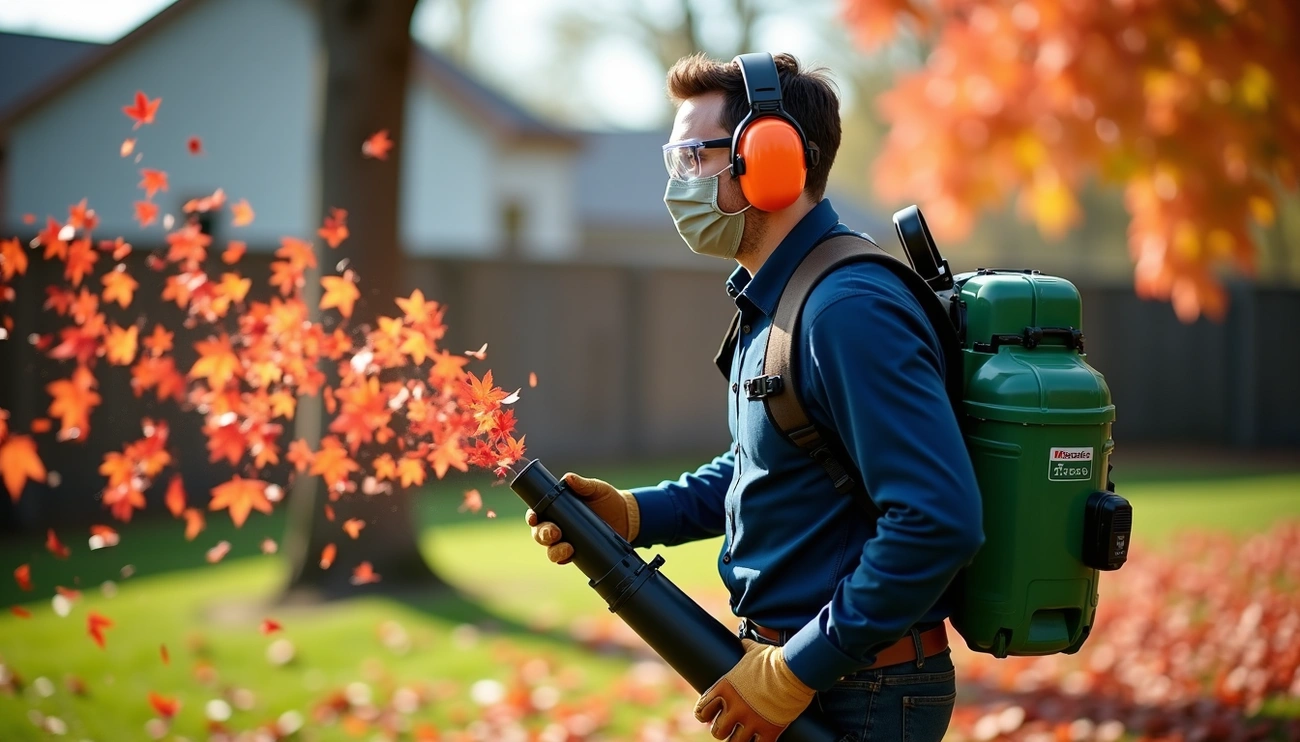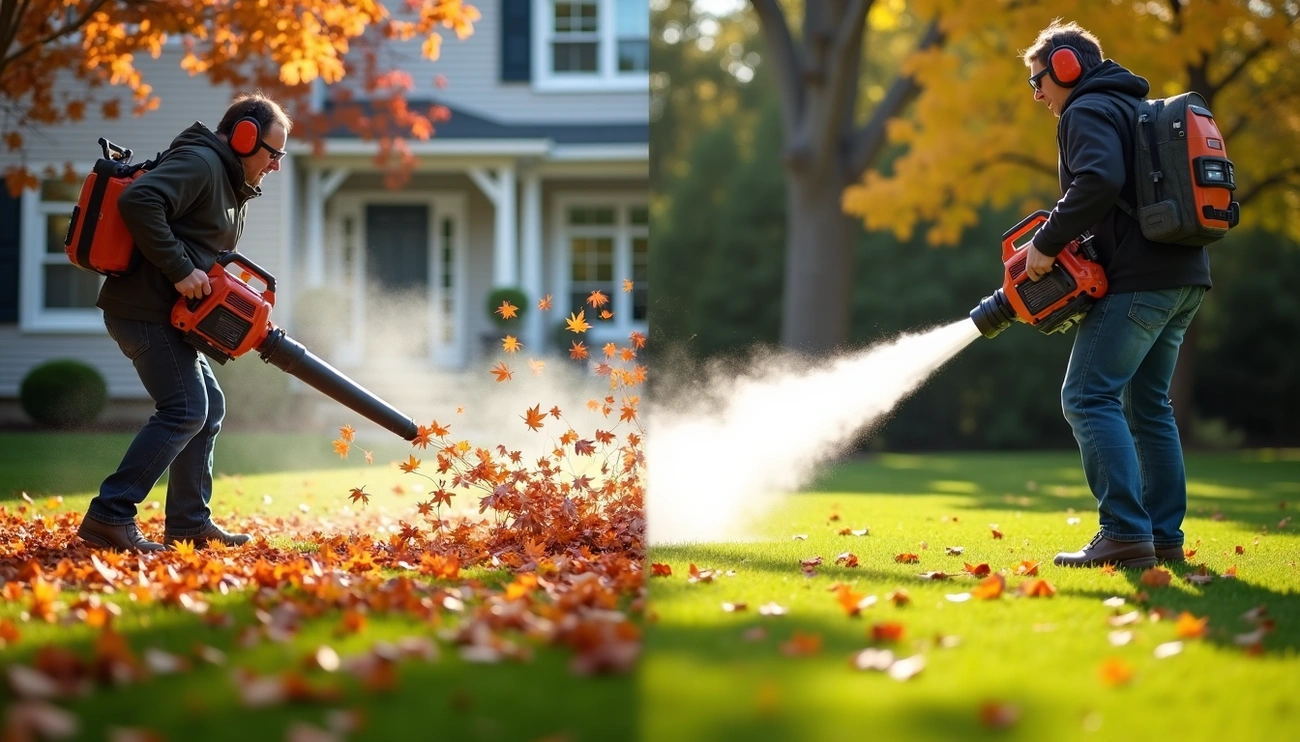
The main difference between gas leaf blowers and battery leaf blowers is power versus convenience. Gas leaf blowers deliver higher airflow and longer run times, making them better for large properties and heavy debris. Battery leaf blowers are quieter, easier to start, require minimal maintenance, and produce zero emissions, which suits most residential yards.
How We Compare Gas and Battery Leaf Blowers
To truly determine whether gas leaf blowers are better than battery models, we need a standardized approach to testing. Testing methodologies have evolved significantly over the years, allowing for more accurate comparisons between these two technologies.
Testing methods and performance metrics
When evaluating gas vs battery leaf blower performance, we rely on several standardized tests that measure real-world capabilities. Consumer Reports and other testing organizations use a comprehensive approach that examines:
- Sweeping performance: Each blower clears a standardized area with the same quantity of leaves. Testers rope off a section of grass, fill it with leaves, and time how long each model takes to clear them completely.
- Loosening capability: This test evaluates how well blowers remove embedded debris. Testers embed synthetic turf with sawdust and rice, then weigh the turf before and after to determine exactly how much material the blower removed.
- Airflow power: The “ball rise” test measures raw power by directing airflow through a vertical tube to lift dimpled batting cage balls. The height achieved indicates the strength of the airflow.
- Noise levels: Sound is measured both at the operator’s ear and from 50 feet away to simulate what both users and neighbors experience. The best models keep volume below 65 decibels, yet the worst exceed 85 decibels (where hearing protection becomes necessary).
- Run time: For battery models, testers fully charge the battery, run the blower on high, and record how long it takes to drain. The best cordless models now reach around 30 minutes, although some still run for as little as 14 minutes.
Additionally, handling factors like weight, control placement, and ease of starting are evaluated to find models that operate effortlessly without causing user fatigue.
Many manufacturers promote their leaf blowers using two key metrics: CFM (cubic feet per minute) and MPH (miles per hour). CFM measures the volume of air a blower moves per minute – higher numbers mean clearing more debris at once. MPH indicates air speed, with higher speeds allowing the blower to move heavier or wet debris more effectively.
Why averages can be misleading
When comparing gas and battery leaf blowers broadly, average performance scores can obscure important distinctions. Consumer Reports engineers analyzed years of testing data and found that averages often fail to tell the complete story.
The central issue lies in how outliers affect averages. Exceptionally good or exceptionally bad models can distort the overall picture. For instance, gas blowers score an average of 4.6 out of 5.5 on sweeping tests, compared to 4.4 for battery models – suggesting minimal difference. However, examining the distribution reveals more nuance.
Some testing organizations visualize this through bell curves showing where most models of each type fall in terms of performance. This approach provides a more accurate representation of what consumers can expect from typical models in each category.
Performance Breakdown: Gas vs Battery Leaf Blower
Looking at raw performance metrics reveals critical differences between these two technologies. Let’s examine how each type truly performs when put to real-world testing.
Sweeping power and airflow
When evaluating sweeping capability, two metrics matter most: CFM (cubic feet per minute) and MPH (miles per hour). CFM measures air volume—how much debris you can move at once—while MPH indicates air speed, crucial for moving heavier items.
Gas leaf blowers typically generate impressive airflow, ranging from 600-1000+ CFM, making them powerhouses for large clean-ups. Battery models generally produce 200-600 CFM, though this gap continues to narrow. Consumer Reports testing shows gas models score an average of 4.6 out of 5.5 in sweeping tests versus 4.4 for electric models.
Loosening embedded debris
Removing wet, matted leaves presents a significant challenge. Gas blowers excel here primarily due to their powerful engines that provide both speed and volume needed to dislodge stubborn debris. Consumer Reports testing gives gas an edge with an average score of 4.1 for loosening versus 3.5 for electrics.
Interestingly, the absolute best electric models actually outperform top gas models in this category—scoring 5.5 versus 4.8 for gas, proving that intelligent design can overcome raw power limitations.
Vacuuming capabilities
Vacuum functionality remains relatively uncommon in leaf blowers overall. Among tested models, only a single battery unit and four gas models offer this feature. The lone battery model with vacuuming capability performed exceptionally well, though gas models with this function generally provide more sustained power for extended vacuuming tasks.
Handling and balance
Gas blowers typically weigh 10-15 pounds due to their engines and fuel tanks, often requiring backpack or wheeled configurations for extended use. Battery models generally weigh 4-8 pounds, making them considerably easier to maneuver.
This weight advantage shows in Consumer Reports’ handling scores, where electric models average 4.4 versus 3.6 for gas models. The best models of both types score identically at 4.9, suggesting top-tier designs can overcome inherent disadvantages.
Noise levels at user and distance
Perhaps the most dramatic difference lies in noise production. Gas leaf blowers typically operate at 65-75 decibels measured from 50 feet away, with some reaching much higher levels at the operator’s ear. The EPA considers noise levels above 75 decibels harmful to human health.
Battery models typically run much quieter. Consumer Reports testing shows electrics scoring an average of 2.9 for operator ear noise versus 1.7 for gas (lower scores indicate worse noise). At 50 feet, the gap widens further with electrics scoring 4.8 versus 2.5 for gas.
Notably, gas blowers produce significant low-frequency noise that travels farther, penetrates walls and windows more readily, and affects more households. Some studies have found this low-frequency component persists at high levels up to 800 feet from the source.
Battery vs Gas Leaf Blower: Runtime and Convenience
The runtime debate remains one of the most decisive factors when choosing between gas and battery leaf blowers. Let’s examine how these technologies compare in day-to-day usage.
Battery charge time and duration
Runtime limitations represent the primary challenge for battery-powered models. Most cordless leaf blowers operate for 15-60 minutes per charge, depending on power settings and battery capacity. During intensive testing, run times varied dramatically—from as little as 8 minutes on certain models to an impressive 30 minutes on the Ego Power+ LB7654.
The good news? Charging technology has improved substantially. Modern batteries recharge in 5 to 48 minutes, with many high-quality models requiring about 90 minutes. The Ego battery fully charges in approximately 110 minutes, whereas the WORX 20V requires about 2 hours.
For extended yard work, consider these runtime factors:
- Power settings (using turbo mode dramatically reduces runtime)
- Battery capacity (higher Ah ratings provide longer operation)
- Temperature (extreme conditions affect performance)
The best performing Husqvarna model delivers over 30 minutes at high power, whereas Ego’s latest high-power model provides about 11 minutes per battery at full power.
Refueling vs recharging
Gas blowers excel in continuous operation—simply refill the tank and continue working. Consequently, gas remains preferable for properties with extensive leaf coverage or dozens of deciduous trees.
In contrast, battery systems offer a unique advantage: platform compatibility. Many manufacturers design batteries that work across their entire outdoor tool lineup. This interchangeability means you can purchase “bare tools” (without batteries) at approximately one-third less cost and rotate batteries between your leaf blower, trimmer, and lawn mower.
For extended battery operation, investing in multiple batteries provides uninterrupted work. The Ego Power+ 880 comes with two 4.0Ah batteries precisely for this purpose.
Portability and ease of use
Regarding ease of use, battery blowers shine brightly. The starting process couldn’t be simpler—attach the battery and pull the trigger. No more wrestling with pull cords, priming, or choke adjustments common with gas models.
Gas blowers typically weigh more due to their engines and fuel tanks, making them less portable despite their cord-free operation. Battery models offer excellent mobility without the hassle of gas or extension cords.
Maintenance requirements likewise favor battery options. Gas blowers demand regular oil changes, air filter replacements, and spark plug maintenance. Battery models require minimal upkeep—mainly keeping batteries properly charged and stored.
For maximum battery life, store batteries at ambient temperatures between 50°F and 68°F with charge levels between 40% and 80%. Avoid extreme temperatures and unnecessary immediate recharging after brief usage.
Environmental and Cost Considerations
Beyond performance considerations, environmental impact and long-term costs often tip the scales when deciding between gas or battery leaf blowers.
Noise and emissions comparison
The environmental differences between these technologies are substantial. Gas-powered leaf blowers generate significantly more noise—typically 65-75 decibels from 50 feet away. The low-frequency component of gas blower noise travels farther, penetrates walls more effectively, and can impact up to 90 surrounding homes, versus just 6 homes for battery models.
Regarding emissions, gas blowers produce startling pollution levels. A half-hour of yard work with a two-stroke leaf blower generates equivalent hydrocarbon emissions to driving a Ford Raptor pickup approximately 3,900 miles—roughly the distance from Texas to Alaska. Moreover, in 2020 alone, gas-powered lawn equipment emitted over 30 million tons of carbon dioxide.
Maintenance and fuel costs
The economic equation increasingly favors battery models. Gas blowers demand regular maintenance including oil changes, air filter replacements, and fuel management. Conversely, battery-powered options have fewer moving parts, requiring minimal upkeep.
Fuel costs create another significant difference. A standard gas backpack blower costs approximately $20 in fuel and oil to run for 8 hours, compared to just $2 in electricity for comparable battery models. This efficiency allows battery blowers to achieve ROI in 2.5-3 years through reduced operational costs.
Battery models featuring brushless motors run 50% longer, deliver 25% more power, and have 10% longer lifespans than those with brushed motors—further enhancing their value proposition.
Battery platform compatibility and savings
Perhaps most compelling is the battery platform ecosystem. Major manufacturers design power systems that work across their entire tool lineup. This interchangeability means:
- Batteries can be shared between leaf blowers, string trimmers, hedge trimmers, and other tools
- “Tool-only” versions can be purchased at significantly lower costs
- Each new compatible tool becomes more affordable
This compatibility essentially creates a 91-94% average annual return on investment for companies switching to battery equipment. As businesses add more tools to their battery arsenal, the economics become increasingly favorable since additional purchases don’t require new batteries.
Which Is Better: Gas or Battery Leaf Blower?
Deciding between gas and battery leaf blowers comes down to your specific situation, not just overall performance. After examining all factors, the decision becomes clear for most homeowners.
Best use cases for gas models
Gas-powered leaf blowers remain unmatched for certain scenarios. Primarily, they excel on large properties exceeding one acre where their extended runtime proves invaluable. For commercial landscapers managing extensive properties or tackling particularly heavy debris, gas models provide the necessary power and endurance. The ability to refuel and continue working indefinitely makes gas blowers practical for properties with dozens of deciduous trees.
Gas models particularly shine in wheeled configurations for quickly clearing sizable areas, though they require about 8 square feet of storage space and typically weigh 100 pounds or more. Professional landscapers often prefer gas options like the Echo PB9010T (approximately $650) for their ability to reduce cleanup time by up to 75% compared to consumer-grade alternatives.
When battery blowers outperform
Battery-powered blowers excel in several critical areas. Firstly, they dominate in noise-sensitive neighborhoods or areas with strict sound regulations. Their significantly lower noise production—comparable to a vacuum cleaner—makes them more neighbor-friendly.
Additionally, battery models offer unparalleled simplicity. You’ll appreciate the straightforward operation without mixing oil and fuel or struggling with pull cords. The minimal maintenance requirements and environmental benefits make battery options increasingly attractive for everyday homeowners.
Choosing based on yard size and needs
Yard size serves as the most reliable deciding factor:
- Small yards (under ¼ acre): A lightweight battery handheld blower provides sufficient power with maximum convenience
- Medium yards (¼-½ acre): Consider a high-capacity battery model or brushless motor for extended runtime
- Large properties (over 1 acre): Gas models typically make more sense, especially with numerous deciduous trees
Ultimately, for most homeowners with typical suburban lots, battery-powered leaf blowers now offer comparable performance with fewer drawbacks. Unless you have an exceptionally large property or require professional-grade equipment, the environmental benefits, quieter operation, and minimal maintenance of battery models make them the superior choice for everyday use.
Conclusion
The landscape of leaf blowers has changed dramatically in recent years. Battery technology has undoubtedly closed the performance gap that once existed between gas and electric models. While gas leaf blowers still deliver slightly higher raw power scores, the best battery models now match or even surpass them in specific performance categories.
Yard size remains the most practical deciding factor when choosing between these technologies. Homeowners with small to medium properties will find battery-powered options offer the perfect balance of power and convenience. Their quieter operation, minimal maintenance requirements, and freedom from emissions make them increasingly attractive for everyday use.