Yes, many modern leaf blowers have a reverse function. These models switch from blowing to vacuuming, allowing users to suck up leaves and debris instead of blowing them away. Blower/vac leaf blowers often include mulching capability and a collection bag, making yard cleanup faster and more efficient with easy mode conversion.
Can Leaf Blowers Be Reversed?
The question of leaf blower reversibility often surfaces during yard work. Let’s clear up the confusion once and for all.
Understanding airflow direction
Leaf blowers operate on a fundamental principle of airflow management. The primary function involves pushing air in one direction—outward—to move debris away from an area. Many homeowners assume all blowers can switch to a vacuum mode, but this isn’t always the case.
Most leaf blowers use centrifugal force to accelerate air radially from the impeller center to the edges. Furthermore, the direction of this airflow is largely determined by the physical design of the impeller and housing, not simply the motor’s rotation. Essentially, reversing the motor won’t change the flow direction because the principle relies on the speed differential between the outer edge and the middle.
Why most blowers don’t reverse
There are several technical reasons why most blowers, including the Stihl BR 200, don’t offer true reverse functionality:
- Design limitations – Many models are engineered specifically for blowing only
- Motor configuration – Particularly with brushless DC motors, reversing the supply may damage the electronic controller
- Efficiency concerns – Even if physically possible, reversed operation often results in dramatically reduced performance
The Stihl BR 200, for instance, functions solely as a blower and cannot be reversed for vacuum use. Unlike vacuum-capable models, it doesn’t include the necessary collection mechanisms or mulching components that would make vacuuming practical.
Common misconceptions about reverse mode
A widespread misconception is that the air control lever on blowers like the Stihl BR 200 allows for switching between blowing and vacuuming modes. However, this lever primarily controls airflow intensity rather than direction.
Another misunderstanding involves equating “reverse” with maintenance procedures. Some users temporarily reverse the blower motor to clear debris from the intake—a practice that should only be done briefly before starting work in a new area, not when the blower is positioned near piles of leaves.
For those who genuinely need vacuum functionality, specialized models exist. These blower/vacuum combinations typically include integrated mulching capabilities that break collected leaves into tiny pieces, compacting them in a collection bag while creating useful garden mulch. The convenience of having one machine for dual purposes makes these models particularly attractive for homeowners with diverse yard maintenance needs.
The Truth About the Stihl BR 200 Blower
Now that we understand the general principles of leaf blowers, let’s examine the Stihl BR 200 specifically to determine its capabilities regarding airflow direction.
Stihl BR 200 specs and design
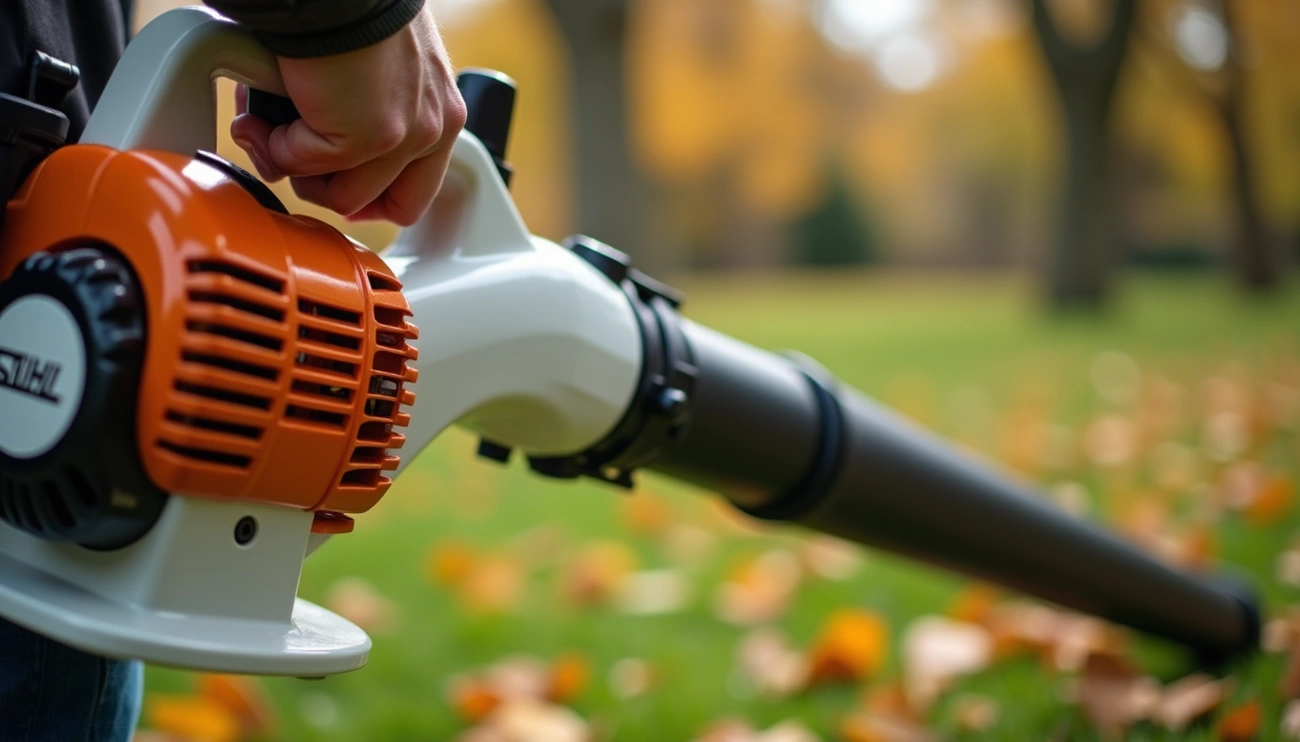
The Stihl BR 200 is a lightweight backpack blower designed primarily for homeowners seeking professional-grade performance. With a displacement of 27.2 cc (1.66 cu. in.), this blower delivers 0.8 kW (1.07 bhp) of engine power. It weighs just 5.8 kg (12.6 lbs) without fuel, making it one of the more comfortable options for extended use.
Performance-wise, the BR 200 generates 12 Newtons of blowing force with an impressive maximum air velocity of 67 m/s (150 mph). The air volume at the nozzle reaches 400 cfm (680 m³/h), which is substantial for most residential cleanup tasks.
Notable design features include:
- Multi-function control handle for single-handed operation
- Anti-vibration system to reduce operator fatigue
- Adjustable support harness for improved weight distribution
- 35.5 oz (1050 cc) fuel tank for extended run time
Why the BR 200 doesn’t support reverse
Contrary to what some users believe, the Stihl BR 200 cannot function as a vacuum. According to authoritative sources, this blower “functions solely as a blower and cannot be reversed for use as a vacuum”.
The misconception likely stems from confusion about the air control lever near the handle. Although this component does control airflow, it adjusts intensity rather than direction. Subsequently, attempts to “reverse” the blower will be unsuccessful as the machine simply lacks the necessary components for vacuum operation.
What the manual says about airflow direction
The official Stihl BR 200 manual clearly states that “the blower is designed for blow-sweeping leaves, grass, paper and similar materials, e.g. in gardens, sports stadiums, car parks and driveways. It is also suitable for blow-sweeping forest paths”.
Moreover, the documentation makes no mention of reverse functionality or vacuum capabilities. The manual explicitly describes the intended single-direction airflow operation, indicating that any expectations regarding vacuum functionality are unfounded.
What to Do If You Need a Vacuum Function
Since the Stihl BR 200 lacks vacuum capabilities, you’ll need to look elsewhere if leaf collection is essential for your yard work. Fortunately, numerous alternatives exist that combine blowing, vacuuming, and even mulching functions.
Alternatives to the BR 200
Looking beyond the Stihl lineup, several manufacturers offer powerful blower/vacuum combinations. The BLACK+DECKER VACPACK stands out as a 3-in-1 system with blowing velocity up to 250 MPH and powerful suction for leaf collection. For those preferring gas power, the Echo ES-250ES vacuum efficiently shreds material after collection, significantly reducing volume.
Blower/vacuum combo models to consider
Among the top-rated options, these models deserve attention:
- Husqvarna 125BVx – Features excellent blowing and very good vacuuming with a durable steel impeller
- STIHL SH 56 C-E – Offers excellent performance in both modes with an Easy2Start system
- Worx TriVac – Switches between blower and vacuum at the turn of a knob with an 18:1 mulching ratio
- Greenworks Cordless Blower/Vacuum – Ideal for smaller spaces with battery-powered convenience
How to choose the right model for your needs
Firstly, consider your yard size. Electric corded models work well for small areas, whereas gas-powered options suit larger properties. Additionally, evaluate leaf conditions—wet leaves require higher CFM ratings.
Think about carrying style too. Handheld units suffice for small lawns, backpack models excel for medium-sized areas, and walk-behind options benefit those with larger properties or physical limitations.
Finally, check mulching capabilities—higher ratios like 16:1 mean fewer bag empties. The best vacuum-capable models typically include metal impellers that effectively shred both leaves and small twigs.
Maintenance Tips to Improve Airflow
Proper maintenance is the key to maximizing your Stihl BR 200’s airflow performance and extending its lifespan. Even the most powerful leaf blower can underperform without regular care.
Check and clean the air control lever
The air control lever on your Stihl BR 200 backpack blower can collect dirt that restricts movement. Consequently, this affects airflow regulation and overall performance. To maintain optimal function:
- Remove visible debris with a dry cloth
- Check if the lever moves freely without sticking
- Ensure the air intake isn’t blocked by leaves or twigs
Most compelling evidence suggests checking this component weekly helps prevent diminished blowing power and maintains consistent airflow.
Inspect throttle and linkage
Whenever your Stihl BR 200 doesn’t rev up properly, the throttle linkage could be the culprit. Generally, issues occur when:
- The throttle cable becomes sticky or bent
- Dirt accumulates around the throttle trigger
- Connections loosen due to regular vibration
Coupled with regular inspection, tightening all screws and bolts prevents safety hazards and extends your blower’s life.
Lubricate moving parts regularly
Above all, proper lubrication prevents friction and wear. For your Stihl BR 200 leaf blower:
Apply light oil to the throttle cable if movement feels stiff Lubricate rotating components that control airflow Use manufacturer-recommended lubricants on moving parts
Equally important is avoiding over-lubrication, which can attract dirt and create new blockages. Monthly inspections ensure all components remain properly maintained and functioning at peak efficiency.
Conclusion
Understanding the true capabilities of leaf blowers, particularly the Stihl BR 200, helps clear up common misconceptions about reverse functionality. Despite what many believe, the Stihl BR 200 works exclusively as a blower and cannot be converted into a vacuum. This limitation stems primarily from its specific design rather than any user error or maintenance issue.
Nevertheless, proper maintenance remains essential for optimal performance. Regular cleaning of the air control lever, inspection of the throttle linkage, and lubrication of moving parts will undoubtedly extend your blower’s lifespan and maintain its blowing power. These simple steps ensure you get the most from your investment.
For those who absolutely need vacuum capabilities alongside blowing functions, several excellent alternatives exist. Models from manufacturers like BLACK+DECKER, Echo, Husqvarna, and Worx offer powerful combination units designed specifically with both functions in mind. When choosing such a model, your yard size, leaf conditions, and personal preferences should guide your decision.