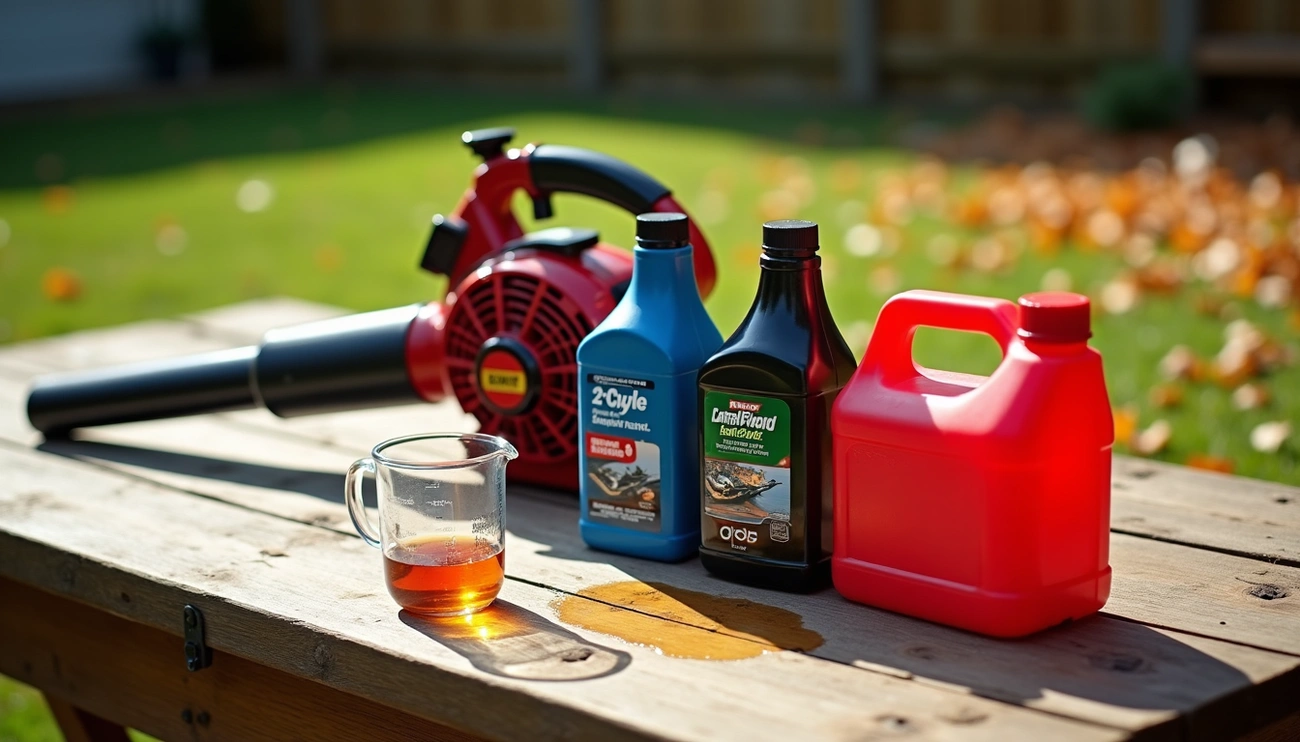
You should not use 2-cycle outboard oil in a leaf blower. Marine 2-cycle oil is formulated for water-cooled engines and cannot handle the higher operating temperatures of air-cooled leaf blowers. Using it can cause poor lubrication or overheating. Use air-cooled 2-cycle oil mixed at the manufacturer’s ratio, typically 50:1.
Understanding 2-Cycle Engines and Oil Requirements
Two-cycle engines power many of our everyday tools, from leaf blowers to chainsaws. Understanding how they work and their oil requirements is essential for keeping your equipment running properly.
What is a 2-cycle engine?
Two-cycle (also called two-stroke) engines complete their power cycle with just two strokes of the piston—one up and one down—during a single revolution of the crankshaft. Unlike four-stroke engines, they combine multiple engine processes in each stroke, making them more compact.
During the upstroke, the piston handles both intake and compression functions. On the downstroke, both power delivery and exhaust occur. This design gives two-stroke engines a higher power-to-weight ratio since they produce power twice as frequently as four-stroke engines. Additionally, they typically contain fewer moving parts, making them lighter and less expensive to manufacture.
Why oil is mixed with fuel
Unlike four-stroke engines that have separate oil reservoirs, two-stroke engines use a “total-loss” lubrication system where oil is mixed directly with gasoline. This mixture serves a crucial purpose—it lubricates the engine’s internal components as it passes through.
Since the crankcase in a two-stroke engine functions as part of the induction tract rather than a closed oil reservoir, the oil must travel with the fuel. The oil-fuel mixture (often called “premix” or “petroil”) distributes throughout the engine to lubricate moving parts.
Essentially, the oil is ultimately burned along with the fuel. This explains why two-stroke engines often produce more smoke and have a distinctive odor during operation.
Common oil mix ratios like 50:1 and 40:1
The mix ratio represents the proportion of gasoline to oil. For example, a 50:1 ratio means 50 parts gasoline to 1 part oil. Converting this to practical measurements, a 50:1 mixture requires 2.6 ounces of oil per gallon of gas.
Common mixture ratios include:
- 20:1 = 6.4 ounces of oil per gallon of gas
- 32:1 = 4.0 ounces of oil per gallon of gas
- 40:1 = 3.2 ounces of oil per gallon of gas
- 50:1 = 2.6 ounces of oil per gallon of gas
Older equipment typically requires richer oil mixtures (more oil), with ratios like 32:1 or even 16:1. In contrast, most modern leaf blowers and similar equipment manufactured after 2003 use leaner 40:1 or 50:1 ratios. This evolution toward leaner ratios has been primarily driven by improved oil formulations and emissions requirements.
Using the correct ratio for your leaf blower is critical—too little oil can cause engine damage from insufficient lubrication, yet too much can lead to excessive smoke and carbon buildup.
Marine vs Air-Cooled Engine Oils
The difference between marine and air-cooled engine oils is substantial, making it unwise to use your boat’s outboard oil in your garden equipment. Let’s examine why these oils are formulated differently and what happens when they’re misused.
What TC-W3 oil is designed for
TC-W3 stands for “Two-Cycle Water-cooled,” a certification administered by the National Marine Manufacturers Association (NMMA). This oil undergoes rigorous testing specifically designed for water-cooled outboard engines. The certification process involves extensive bench tests evaluating fluidity, miscibility, rust prevention, and compatibility. Moreover, the oil must pass demanding engine tests using Johnson 40hp and Mercury 15hp engines to prove its ability to prevent ring sticking and carbon buildup.
Generally, TC-W3 oils are formulated with brightstock that helps keep additive packages active in the combustion chamber, allowing dispersants and detergents to clean more thoroughly. These special additives help combat the unique challenges faced by marine engines, including moisture concerns and corrosion protection.
Why air-cooled engines need different oil
Air-cooled engines like those in leaf blowers operate under entirely different conditions than their water-cooled counterparts. Primarily, air-cooled engines run at considerably higher temperatures without the cooling efficiency that water provides. This temperature difference fundamentally changes the oil requirements.
Furthermore, air-cooled engines need oil formulations that can withstand these elevated temperatures without breaking down prematurely. The oil must maintain proper viscosity at higher operating temperatures to protect critical engine components.
Temperature and combustion differences
Temperature variations between marine and air-cooled engines create distinct performance environments. Water-cooled engines maintain more stable operating temperatures, whereas air-cooled engines experience wider temperature fluctuations.
Indeed, these temperature differences affect how the oil-fuel mixture burns. In air-cooled engines, higher cylinder temperatures require oils with better high-temperature stability. Alternatively, using marine oil in an air-cooled engine can lead to incomplete combustion, increased carbon deposits, and potential ring sticking.
Hence, despite both being 2-stroke oils, the formulations serve fundamentally different purposes based on their cooling methods and operating temperatures.
Can You Use Marine 2-Cycle Oil in a Leaf Blower?
Many homeowners wonder if they can substitute marine 2-cycle oil in a leaf blower when regular oil is unavailable. The answer depends on how often you plan to use this solution.
Short-term vs long-term effects
For one-time emergency use, marine outboard oil might not cause immediate damage to your leaf blower. Primarily, it will lubricate the engine components enough for brief operation. Nevertheless, extended use poses significant risks because these oils aren’t formulated for high-temperature air-cooled engines.
Risks of carbon buildup and ring sticking
Using marine 2-cycle oil in your leaf blower can lead to serious long-term issues. First, excessive carbon deposits may accumulate on engine components. Plus, these deposits can cause piston rings to become stuck in their grooves. According to user reports, the spark arrestor can become “as gummed up as ever seen”. Unfortunately, ring sticking often leads to compression problems and eventual engine failure.
What manufacturers recommend
Equipment manufacturers explicitly advise against using marine oils. Husqvarna recommends a proper 50:1 fuel mixture using designated air-cooled engine oils. Another manufacturer’s manual clearly states: “Avoid using automotive lubricants or 2-cycle outboard lubricants”. Instead, they suggest “high-quality synthetic 2-cycle lubricant” specifically designed for air-cooled engines.
Real-world user experiences
Although some users report using marine oil without immediate problems, experienced mechanics caution against this practice. As one mechanic noted, “You will get overheating like you can’t believe”. Another user explained, “Excessive deposits or spooge out the exhaust can be a problem in the long run”.
Best Practices for Leaf Blower Oil Use
Proper maintenance of your leaf blower begins with using the right oil and mixing it correctly. Following best practices ensures optimal performance and longevity of your equipment.
Choosing the right 2 stroke oil for leaf blower
For leaf blowers, select oil specifically formulated for air-cooled engines. Look for JASO-FD rated oils, which meet high-quality standards for air-cooled two-stroke engines. Popular options include Echo Red Armor, Husqvarna XP, and Stihl HP Ultra. Synthetic or synthetic blend oils typically outperform conventional oils by keeping spark arrestors cleaner. Notably, never use motor oil as it will damage your engine.
How to mix oil and gas properly
For modern leaf blowers, the standard ratios are:
- 40:1 = 3.2 oz oil per gallon of gas
- 50:1 = 2.6 oz oil per gallon of gas
First, check your owner’s manual for the recommended ratio. Then, pour the oil into a clean gas can before adding fresh gasoline (87 octane minimum). Shake thoroughly for 10-15 seconds to ensure proper mixing. For precision, measure oil carefully rather than eyeballing it.
How to store mixed fuel safely
Mixed fuel has a limited shelf life of approximately 30 days. Subsequently, prepare only what you’ll use within a month. Label your gas can clearly to avoid accidentally using it in other equipment. Prior to seasonal storage, drain the fuel tank completely. For extended shelf life, consider adding fuel stabilizer when mixing.
Signs of oil-related engine issues
Watch for warning signals of improper oil use. Primarily, horrendous noise followed by sudden shutdown suggests inadequate mixing. Excessive smoke indicates too much oil, while difficulty starting may signal too little oil or stale fuel. Carbon buildup and seized pistons are serious consequences of using inappropriate oil.
Conclusion
Throughout this article, we’ve seen why substituting marine 2-cycle oil in your leaf blower remains a risky practice. Most notably, the fundamental differences between water-cooled and air-cooled engines demand specific oil formulations for each. Your leaf blower operates at significantly higher temperatures than outboard motors, therefore requiring oils designed to withstand these conditions.
While emergency use might not cause immediate damage, long-term application of marine oil will likely result in carbon deposits, ring sticking, and eventual engine failure. Additionally, manufacturers explicitly recommend against this practice for good reason.
The best approach for maintaining your leaf blower involves selecting oil specifically formulated for air-cooled engines, preferably those with JASO-FD ratings. Similarly, mixing at the correct ratio (typically 40:1 or 50:1 for modern equipment) ensures proper lubrication without excessive smoke or deposits.