Yes, a leaf blower can be used to propel a small boat or kayak as a DIY experiment. It works by directing airflow into or across the water, but performance is slow, inefficient, and very noisy. Leaf blowers are novelty solutions, not practical replacements for boat motors.
Why Try a Leaf Blower as a Boat Motor?
The DIY spirit runs deep in backyard engineering circles. When it comes to boat propulsion, thinking outside the box often leads to unconventional experiments that might seem ridiculous at first glance. But these experiments can be surprisingly educational.
Curiosity and DIY culture
My fascination with using a leaf blower as a boat motor wasn’t just about finding a cheaper alternative to traditional boat blowers. It stemmed from the same curiosity that drives countless viral videos of homemade contraptions. Online platforms are filled with enthusiasts bolting leaf blowers onto fishing boats, creating makeshift motors from weed whackers, and pushing the boundaries of what’s possible with household tools.
This experiment sits at the intersection of maker culture and practical problem-solving. DIY boat propulsion has a rich history – from simple paddle-wheel designs to more complex motorized systems. Furthermore, there’s something undeniably satisfying about repurposing everyday tools for unexpected uses.
Comparing to traditional boat motors
Traditional boat blower motors offer reliability, efficiency, and purpose-built performance. In contrast, leaf blowers present several notable differences:
- Thrust capacity: Most cordless blowers deliver roughly 5-25 pounds of force (≈22-111 N) of static thrust, while purpose-built outboards provide significantly more power.
- Water resistance: A typical solo canoe requires only a few pounds of thrust to move at 1-2 mph on calm water, but resistance increases exponentially with speed.
- Practicality: Leaf blowers lack water-specific features like sealed components and cooling systems.
High-end leaf blowers might move a lightly loaded boat at 1-3 mph in ideal conditions, primarily useful for short trips on calm lakes or as emergency backup. Nevertheless, they cannot match the efficiency of dedicated boat engine blowers.
What we hoped to learn
Beyond pure entertainment value, our experiment had practical learning objectives. We wanted to determine:
- Whether a consumer-grade leaf blower could provide sufficient thrust for meaningful movement
- How battery life would translate to water travel distance
- What mounting configurations would maximize efficiency
- If this could serve as a viable emergency propulsion option
Ultimately, we hoped to answer a fundamental question – is this just a novelty, or could it actually work in practical scenarios? A leaf blower pushed to its limits might reveal surprising insights about improvised propulsion systems that could be valuable in emergency situations.
Setting Up the Experiment
Preparing for our unconventional water adventure required thoughtful planning. Unlike traditional boat blowers that are designed specifically for marine use, we needed to adapt everyday yard equipment for water propulsion.
Choosing the right leaf blower
For this experiment, I decided to test both battery-powered and gas options. Gas-powered leaf blowers (200 MPH) generally offer more sustained power for longer journeys. Through research and testing, we borrowed several models to determine which would provide adequate thrust without being too heavy or unwieldy. The goal was finding blowers powerful enough to move our boat yet portable enough to mount securely.
Boat type and weight considerations
The vessel selection proved crucial to our success. Boat weight directly impacts how much thrust is needed. Following marine guidelines, I selected a lightweight tugboat design that would respond well to the moderate thrust a leaf blower could provide. Based on recommendations, we ensured our total boat weight (including people and gear) remained minimal since proper motor selection depends heavily on this factor.
Mounting the blower safely
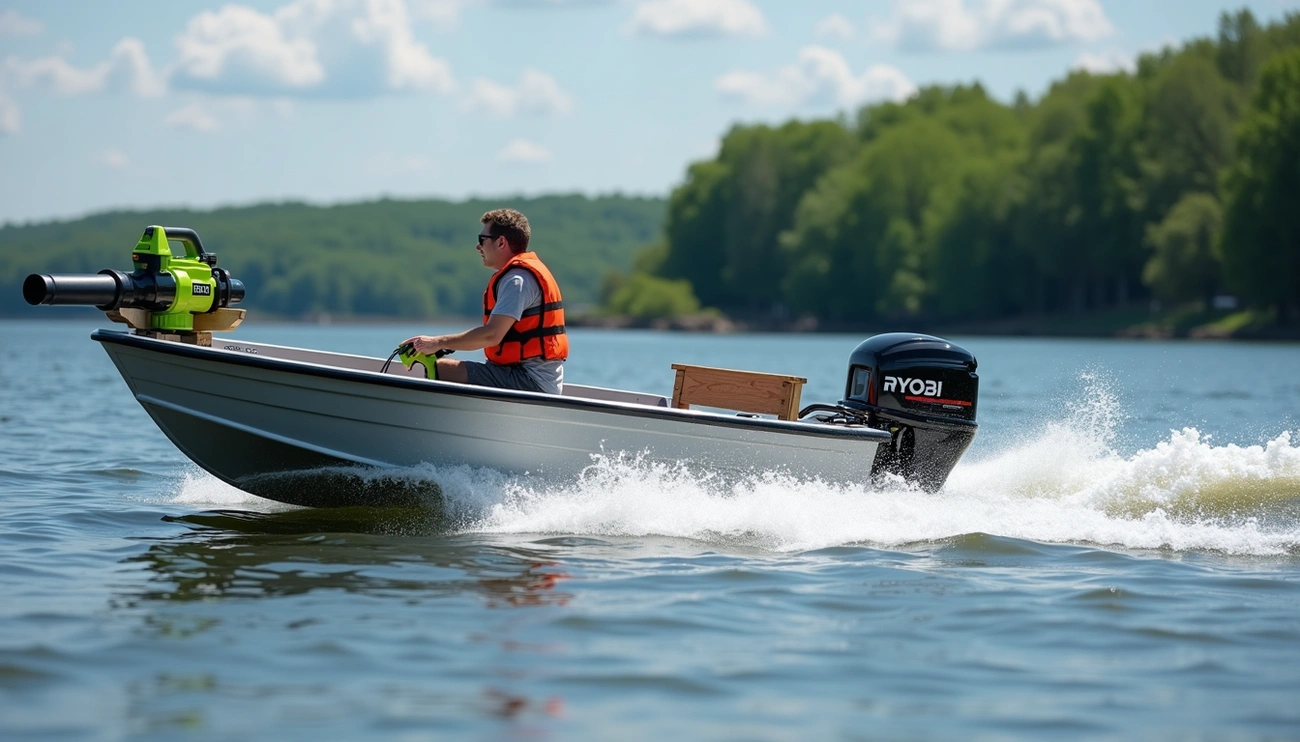
Securing the boat blower motor properly presented an engineering challenge. Previous attempts by others showed that handheld operation caused dangerous wobbling. Instead, I crafted a mounting system using a T-shaped piece of tubing that cradled the blower’s back axle, similar to what others had done with golf carts. Additionally, we used tension straps to secure the handle to prevent unintended movement during operation.
Safety gear and precautions
Safety remained our top priority throughout. We wore appropriate protective gear including life vests and gloves. Before launching, I thoroughly inspected all mounting points and ensured our boat bilge blowers were positioned correctly to prevent overheating. Moreover, we conducted our experiment in calm, shallow waters with minimal boat traffic, keeping emergency supplies readily available. Following DIY boating safety guidelines, we also maintained proper ventilation to prevent any potential buildup of fumes.
Testing the Leaf Blower on Water
The moment of truth arrived once we pushed our leaf-blower-powered creation into the water. Excitement mixed with skepticism as I fired up our improvised boat blower.
Initial launch and first impressions
The leaf blower roared to life, creating immediate thrust that pushed our small vessel forward with surprising effectiveness. Despite looking ridiculous, our contraption actually moved! The initial acceleration was jerky yet produced enough force to overcome the boat’s inertia. Notably, watching this unusual setup in action was even more entertaining than anticipated.
Speed and control observations
On calm water, our makeshift boat blower motor pushed the lightly loaded vessel at approximately 1-3 mph. This modest speed, though far from impressive compared to conventional boat engine blowers, proved sufficient for basic movement. Turning required coordination between thrust direction and paddle assistance.
Handling and steering challenges
Steering presented the greatest hurdle. Without a rudder or swivel mount, directional control demanded constant adjustment. Subsequently, we discovered that mounting position significantly affected stability—lower placement provided better balance than higher positions that created unwanted yaw.
Battery life and runtime
The cordless blower’s battery lasted approximately 10-40 minutes under full throttle, limiting our practical range. Running continuously at high power drained the battery considerably faster than yard work would, consequently restricting our adventure’s duration.
Noise levels and comfort
Above all, the noise proved most memorable. At the operator’s position, the leaf blower generated 95-115 decibels—comparable to a chainsaw and well above the 85-decibel threshold where hearing damage begins. Yet modern electric models like the RYOBI Whisper series (at 57 dB) offered significantly quieter operation than gas models, though still far from silent.
What We Learned from the Test
Our experiment yielded fascinating results that would surprise most boat blower enthusiasts.
Was it powerful enough?
The leaf blower produced sufficient thrust to move our boat, albeit slowly. In calm conditions, we achieved speeds of 1-3 mph, which proved adequate for short trips. The key was finding the right angle—when positioned correctly, our makeshift boat blower motor created enough force to push the vessel steadily forward.
How it compares to a real boat blower motor
Realistically, our leaf blower setup couldn’t match dedicated marine equipment. Traditional boat engine blowers offer waterproofing, longer runtime, and more consistent power delivery. Most consumer leaf blowers deliver only 5-25 pounds of force, whereas purpose-built outboards generate substantially more thrust with better efficiency.
Unexpected pros and cons
Surprisingly, the experiment wasn’t a complete failure. On the positive side, setup was straightforward and the immediate response was impressive. The drawbacks became apparent quickly—limited runtime of 10-40 minutes under full throttle, difficulty steering, and the wild noise levels made conversation impossible.
Would we do it again?
Absolutely. Despite limitations, the chaotic yet functional experiment provided invaluable insights. For emergency propulsion on calm water or short-distance travel, a leaf blower might serve as an unconventional yet viable alternative to traditional boat bilge blowers. Naturally, for serious boating, we’d stick with equipment designed specifically for water use.
Conclusion
Our leaf blower boat motor experiment certainly proved both educational and entertaining. Though unconventional, the makeshift propulsion system actually worked, albeit with clear limitations. Most importantly, we discovered that ordinary yard equipment can indeed move a small vessel across calm water at modest speeds of 1-3 mph.
Nevertheless, practical constraints became evident during our testing. Battery life restricted our journey to under an hour, while steering challenges and noise levels presented additional obstacles. Despite these drawbacks, the experiment demonstrated the creative potential of repurposing everyday tools for emergency situations.
Additionally, this quirky adventure highlighted the vast difference between purpose-built marine equipment and improvised solutions. While dedicated boat motors offer reliability, waterproofing, and sustained power, our leaf blower alternative provided just enough thrust for basic movement – certainly not enough for serious boating needs.