Dom Quinto is widely credited with inventing the first practical leaf blower in the late 1950s. He adapted a Japanese agricultural sprayer for lawn care use. Other contributors, including H. L. Diehl with wheeled models and Kyoritsu Noki (Echo), helped refine and popularize leaf blowers in the United States.
The accidental invention of the leaf blower
The story of the leaf blower begins with an accidental discovery that transformed agricultural equipment into a popular garden tool. Unlike many inventions with clear origins, the leaf blower emerged through adaptation rather than deliberate design.
From crop duster to garden tool
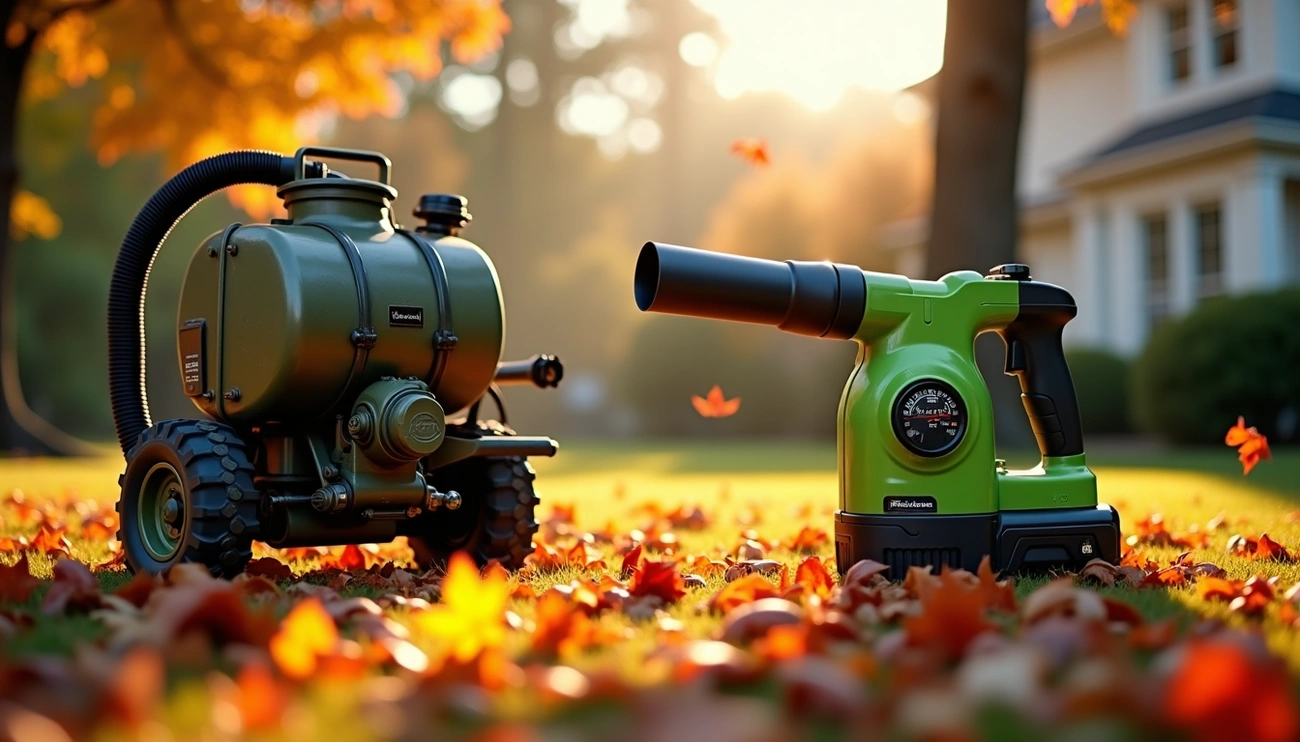
The leaf blower’s origins trace back to agricultural technology. Initially, these machines were gas-powered backpack crop dusters designed specifically for spraying pesticides in plant nurseries. These early devices consisted of a powerful engine that drove a high-speed fan, creating strong air currents to distribute chemicals across crops and orchards. The basic mechanism was straightforward yet effective – an engine powered a fan inside a tubular housing, producing a concentrated stream of air through a nozzle.
Notably, these agricultural sprayers featured dual capabilities. The engine not only drove the fan (similar to modern leaf blowers) but also operated a pump that pushed liquids through an adjustable nozzle at the end. This design allowed farmers to disperse chemicals up to 11 meters away, making them particularly useful for reaching tall trees and dense foliage.
How early users repurposed the sprayer
The transformation from crop duster to leaf blower happened organically. Farmers and nursery workers discovered that by simply not adding pesticides to the tanks, these powerful machines could efficiently move leaves and debris. This innovation spread primarily through practical necessity rather than marketing – users were essentially hacking their equipment to serve a new purpose.
By the late 1950s, this repurposing became widespread enough that manufacturers took notice. Consumers began deliberately dismantling the chemical dispensing components, using only the blowing unit. Equipment manufacturers recognized the market opportunity and began producing dedicated leaf-moving machines without the spraying components.
When was the leaf blower invented?
Pinpointing exactly when the first true leaf blower appeared depends on whether we mean the original dual-purpose equipment or dedicated leaf-moving devices. The Japanese company Kyoritsu Noki introduced their first backpack power fogger/duster in 1947, followed by a series of backpack blower misting machines in 1955. Nevertheless, they didn’t apply for a patent until 1968.
Concurrently, Dom Garofalo filed one of the earliest U.S. patents specifically for a “leaf blower” in 1972 (patent #3,633,380). The commercial breakthrough came in 1978 when Echo launched what many consider the first petrol-powered handheld blower. This innovation made the technology accessible to average homeowners, fundamentally changing yard maintenance forever.
The race to claim the invention
Several individuals and companies compete for the title of leaf blower inventor, with historical records offering conflicting accounts of this garden tool’s genesis.
Kyoritsu Noki and the Echo legacy
The Japanese firm Kyoritsu Noki (later Echo) has perhaps the strongest documented claim. Founded in 1947, the company introduced a backpack power fogger/duster that same year, followed by backpack blower misting machines in 1955. Kyoritsu officially applied for a backpack power mist sprayer patent in 1968.
During a California drought, landscapers modified the company’s DM-9 sprayer by removing the liquid tank and sealing the hole. This improvised solution became, according to company records, “the first ever power blowers”. Responding to this innovation, Echo engineers visited California and subsequently launched the PB-9, marketed as the first dedicated power blower. By 1970, Kyoritsu had released its first backpack blower, followed by the first handheld power blower in 1977.
Aldo Vandermolen’s disputed contribution
Meanwhile, Dutch-American businessman Aldo Vandermolen’s obituary claims he “made one of the biggest contributions to the landscaping industry by creating the backpack leaf blower and subsequently, the first handheld gas-powered leaf blower”. His company allegedly began exporting two-stroke backpack blowers in the 1960s.
Despite these claims, researchers note “there are no patent applications from Aldo or the Vandermolen Corporation for a backpack blower, mister, or sprayer, which would verify and date this claim”.
Dom Quinto and the U.S. connection
Dom Quinto frequently appears in leaf blower origin stories. According to multiple sources, Quinto invented the leaf blower in the late 1950s as an agricultural chemical sprayer. Manufacturers supposedly discovered customers were removing the chemical dispensing component and using only the blower function. Yet these accounts lack verifiable documentation—Wikipedia’s mention of Quinto is notably “unsourced”.
Who invented the first leaf blower?
Additionally, H.L. Diehl Company (later Giant Vac) claims to have developed one of the first walk-behind leaf blowers in 1959. This company was eventually acquired by Sgag Power Equipment in 2012 and still produces walk-behind blowers.
Given these competing narratives, many experts conclude “the original inventors [were] the hackers who had the idea of dismantling the crop dusters”. This pragmatic view acknowledges that true innovation often comes from users adapting existing tools for new purposes.
How leaf blowers evolved over the decades
Leaf blowers underwent remarkable evolution after their initial introduction, transforming from specialized agricultural equipment to mainstream garden tools over several decades.
Rise of handheld and backpack models
The transition from repurposed crop dusters to dedicated leaf-moving tools began with Kyoritsu Noki (later Echo) introducing their first backpack power blower in 1970. A more significant breakthrough came in 1977 with the release of the first handheld power blower. This innovation made the technology accessible to average homeowners, fundamentally changing yard maintenance practices. Both designs offered distinct advantages—backpack models provided comfort for prolonged use, whereas handheld units offered greater maneuverability for smaller tasks.
The 1980s boom in consumer adoption
Throughout the 1980s, leaf blowers skyrocketed in popularity. Companies including Weed Eater, Stihl, and McCulloch/Husqvarna recognized the growing market and began introducing their own leaf blower product lines. By 1989, almost one million leaf blowers were sold annually in the United States. Ironically, drought conditions in California facilitated acceptance of leaf blowers as water use for garden clean-up was prohibited. Many viewed them as environmentally responsible alternatives to wasteful hose cleaning.
Cleaner engines and electric alternatives
Early leaf blowers primarily featured two-stroke engines, which were lightweight and powerful but notoriously dirty. Facing California’s stringent emissions regulations implemented in stages by 1995 and 1999, manufacturers developed cleaner two-stroke engines and introduced four-stroke alternatives. Meanwhile, electric options emerged, with corded models reducing both noise and emissions considerably. By 1998, industry shipments of gasoline-powered handheld and backpack leaf blowers increased 30% over the previous year, reaching 1,868,160 units nationwide.
How does a leaf blower work?
Modern leaf blowers operate through a surprisingly straightforward mechanism. When powered on, either an electric motor or gasoline engine drives a component called an impeller (essentially a fan with multiple blades). This rotating impeller creates centrifugal force, drawing air through intake vents and then expelling it forcefully through the nozzle. The speed and volume of this airflow—measured in MPH (miles per hour) and CFM (cubic feet per minute) respectively—determine the blower’s overall power and effectiveness.
The future of leaf blowers and their impact
The leaf blower industry stands at a crossroads as environmental concerns reshape the future of these garden tools.
Battery-powered innovations
Battery-powered leaf blowers have made remarkable strides, now offering performance comparable to gas models but with less noise and weight. Manufacturers like Husqvarna feature innovations such as instant start, fan speed control, and boost mode in their cordless models. Consumer Reports testing confirms that cordless blowers have evolved from niche products into viable alternatives to heavy-duty gas equipment. Furthermore, battery backpack models typically deliver more power and longer run times than their handheld counterparts.
Environmental regulations and city bans
More than 200 cities, counties and local jurisdictions have either banned gas-powered leaf blowers, restricted their use, or created incentives for electric alternatives. California implemented a state law banning the sale of new gas-powered leaf blowers beginning January 1, 2024. Similarly, Washington, D.C.’s Leaf Blower Regulation Amendment Act subjects violators to fines up to $500 per offense. In response, some Republican-led states like Texas and Georgia have prohibited local governments from regulating gas-powered equipment.
Balancing convenience with sustainability
While electric models offer environmental benefits, the transition presents challenges. At USC, switching to rechargeable electric equipment required a $120,000 investment. Given these points, many municipalities offer rebates or trade-in programs to ease transition costs. Ultimately, some experts suggest reconsidering our esthetic expectations—allowing some leaves to remain naturally benefits soil health and provides shelter for beneficial insects.
Conclusion
The leaf blower’s journey from repurposed agricultural equipment to controversial garden tool reveals fascinating insights about innovation and adaptation. Throughout this exploration, we’ve seen how practical necessity drove farmers and nursery workers to transform crop dusters into leaf-moving devices. Companies like Kyoritsu Noki, alongside figures such as Dom Quinto and Aldo Vandermolen, all played roles in this evolutionary story, though definitive credit remains elusive.
Undoubtedly, leaf blowers transformed yard maintenance practices during the 1980s boom, with nearly one million units sold annually by decade’s end. Their convenience came with consequences, however, as growing awareness of pollution and noise issues prompted regulatory responses. Many cities now restrict or ban gas-powered models altogether, especially following research showing their environmental impact exceeds that of some vehicles.