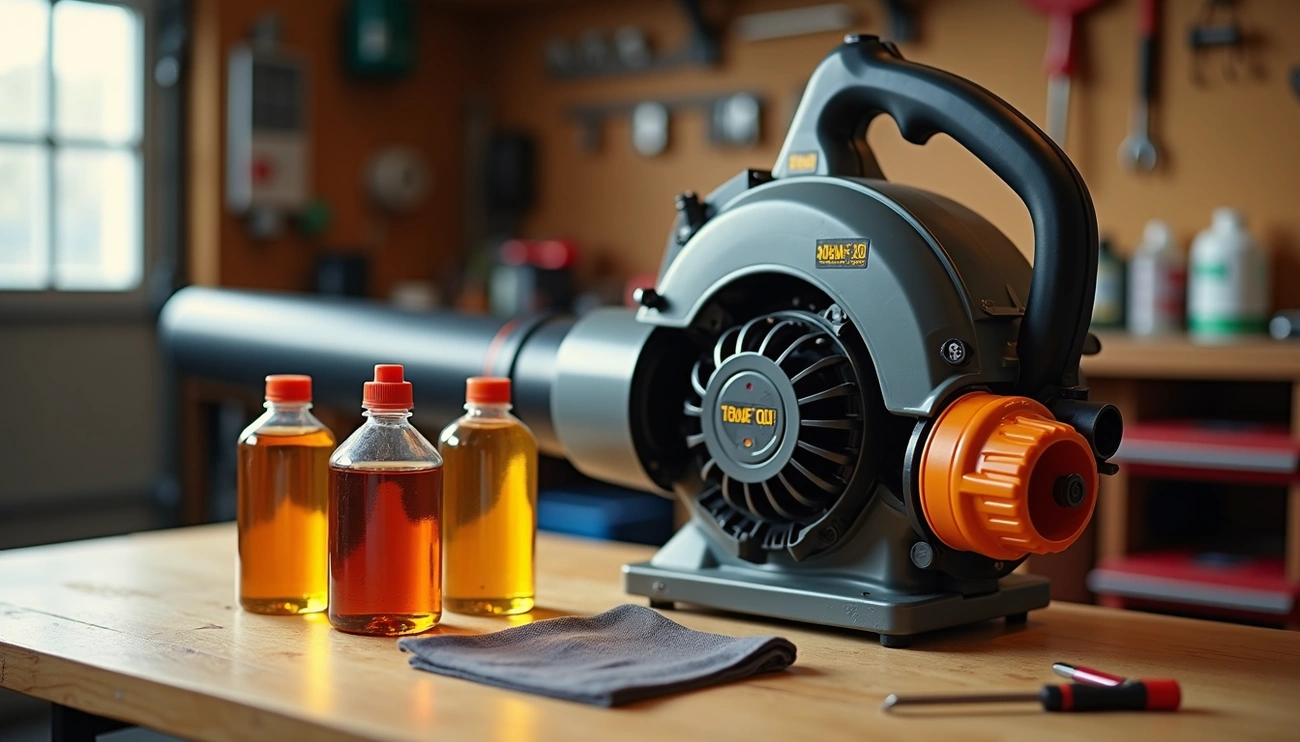
Yes, 5W-30 oil can be used in many 4-cycle leaf blowers. It flows well in cold weather and provides adequate engine protection. However, 2-cycle leaf blowers require oil mixed with fuel, and some 4-cycle engines specify SAE 30 or 10W-30. Always follow the owner’s manual.
Understanding Engine Oil Grades
Engine oil grades often appear mysterious with their combinations of numbers and letters. First and foremost, understanding these codes helps you make informed decisions about the proper oil for your leaf blower or other small engines.
What does 5W-30 mean?
The Society of Automotive Engineers (SAE) developed a numerical coding system to grade motor oils according to their viscosity characteristics. In a designation like 5W-30, each part has a specific meaning. The number before the “W” (which stands for Winter, not weight) describes the oil’s viscosity at low temperatures. The lower this number, the thinner the oil and the better it flows when cold. The number after the W represents the oil’s viscosity at normal operating temperature, typically measured at 100°C (212°F).
A 5W oil must meet specific performance requirements, including a maximum cranking viscosity of 6600 cP at -30°C (-22°F). This technical standard ensures reliable cold-weather performance for your equipment.
How viscosity changes with temperature
Viscosity—essentially an oil’s resistance to flow—is inversely proportional to temperature. As temperatures drop, oil viscosity increases (becomes thicker); as temperatures rise, viscosity decreases (becomes thinner). This natural property creates a challenge for engines operating across varying conditions.
For leaf blowers and similar equipment, this temperature-viscosity relationship is crucial. Cold, thick oil can’t flow quickly to reach critical components during startup, leaving them vulnerable to wear. Conversely, if oil becomes too thin at high temperatures, it loses film strength and the ability to prevent metal-to-metal contact.
Why multi-viscosity oils are used
Multi-grade oils like 5W-30 were developed approximately 50 years ago to eliminate the routine of using thinner oil in winter and thicker oil in summer. They offer several advantages:
- One oil for year-round use
- Improved low-temperature starting
- Less battery drain
- Excellent high-temperature performance
- Improved overall fuel economy
These benefits are achieved through special additives called viscosity index improvers—specialized polymers that react dynamically to temperature changes. At lower temperatures, these polymers remain small, but as the engine warms, they expand, effectively thickening the oil. This adaptability allows multi-viscosity oils to provide consistent protection regardless of operating conditions.
For your leaf blower engine, this means reliable starting on cold mornings while maintaining protection during operation as the engine heats up—a perfect balance of performance across temperature ranges.
Can You Use 5W-30 in a Leaf Blower?
Leaf blowers come in two distinct engine types, and choosing the right oil depends entirely on which type you own. Understanding your equipment’s specific requirements is crucial for proper maintenance and longevity.
Typical engine types in leaf blowers
Most leaf blowers fall into one of two categories:
- Two-cycle (2-stroke) engines: These simpler engines require oil mixed directly with gasoline. They’re typically lighter, less expensive, and commonly found in handheld blowers.
- Four-cycle (4-stroke) engines: These more complex engines have separate chambers for oil and fuel. They’re generally found in more powerful backpack or wheeled models and tend to run cleaner.
Identifying your engine type is the first step in determining what oil to use. Look for labels on the fuel cap or check your owner’s manual if you’re unsure.
Is 5W-30 compatible with 2-cycle and 4-cycle engines?
For 4-cycle leaf blowers, 5W-30 oil is often an excellent choice, especially in colder weather. Toro specifically recommends 5W-30 Winter Engine Oil for their 4-cycle engines to enable “easy starting and maximum engine protection in cold weather.” This oil is “formulated with High quality base oils” designed specifically for 4-cycle equipment.
Additionally, many users report better cold-weather starting with 5W-30 synthetic oils. As one experienced user noted, “Briggs and Stratton recommends the synthetic 5w30 over others – greater oil flow for better starting from low viscosity of the 5W”.
For 2-cycle engines, furthermore, 5W-30 motor oil is not compatible and should never be used. These engines require special 2-stroke oils designed to be mixed with fuel. Husqvarna, for instance, recommends their specific XP 2-stroke oil for professional users.
Manufacturer recommendations and warranty concerns
Above all, following manufacturer guidelines is essential for maintaining warranty coverage. John Deere, for example, specifically formulates their Turf-Gard™ Engine Oil (available in 5W-30) to “meet or exceed the engine warranty requirements of leading manufacturers”.
For this reason, using improper oil can potentially void your warranty. As one industry expert noted, “maintaining the units according to manufacturer specifications while still under warranty” is “a good idea” despite minor differences in recommended oil types.
Most importantly, 5W-30 is only appropriate for 4-cycle engines—never attempt to substitute it in a 2-cycle engine where oil-fuel mixtures are required.
5W-30 vs SAE 30 and Other Common Oils
Understanding oil differences helps you make the best choice for your leaf blower’s engine life and performance. Let’s explore common oil types and their ideal applications.
SAE 30 vs 5W-30: Key differences
First and foremost, SAE 30 is a single-grade oil with consistent viscosity, whereas 5W-30 is a multi-grade oil that changes viscosity with temperature. Although both have the same thickness at normal operating temperature (212°F), they behave differently when cold. The “5” in 5W-30 indicates it flows better in cold temperatures, making starting easier, while SAE 30 remains thick when cold.
When to use SAE 30 instead
SAE 30 works best at temperatures above 40°F. It’s typically recommended for small engines with air cooling that operate in consistent, warmer conditions. As a bonus, single-grade oils like SAE 30 are often less expensive than multi-grade alternatives. Nevertheless, using SAE 30 in freezing temperatures may result in difficult starting.
How 10W-30 compares
10W-30 represents a middle ground – thicker than 5W-30 in cold weather but identical at operating temperature. API guidelines suggest using 10W-30 when temperatures stay above 0°F (-18°C). Many users report that pull starts are significantly easier with 10W-30 compared to straight SAE 30.
Synthetic vs conventional oil
Synthetic oils maintain consistent viscosity longer and withstand extreme temperatures better than conventional oils. For leaf blowers experiencing hard starting or oil burning issues, switching to synthetic might help. Synthetic formulations typically flow better at cold temperatures while providing superior protection at high temperatures.
Best Oil Choices for Leaf Blowers
Choosing optimal lubricants extends your leaf blower’s lifespan substantially. As an outdoor equipment owner, I’ve found that matching oil to your specific engine type is crucial.
What kind of oil for leaf blower?
The leaf blower oil type depends primarily on your engine design. Two-cycle engines require special two-cycle oil mixed directly with fuel at a specific ratio (typically 50:1). Never use automotive lubricants in these engines. Four-cycle engines, meanwhile, need regular engine oil in a separate reservoir.
Recommended oils for 4-cycle engines
For 4-cycle leaf blowers, high-quality detergent oils meeting API service category SJ or newer provide optimal protection. Briggs & Stratton specifically recommends synthetic 5W-30 as their top choice for all temperatures from -20°F to +120°F. Many professionals use premium synthetic options like Mobil 1, which offers superior protection even with extended use.
Temperature-based oil selection
Ambient temperature greatly impacts oil selection. Synthetic 5W-30 performs excellently across most temperature ranges, making it ideal for year-round use. Notably, conventional oils typically last about 2000 hours at 180°F, whereas synthetic oils can last approximately 6000 hours under identical conditions.
Can 5W-30 be used in a lawn mower too?
Absolutely! Most modern lawn mowers with 4-stroke engines accept 5W-30 oil. In fact, many manufacturers consider synthetic 5W-30 ideal for both leaf blowers and lawn mowers, particularly in cold weather. Users consistently report easier starting and zero oil consumption when using synthetic 5W-30.
Conclusion
Throughout this article, we’ve explored the question of whether 5W-30 oil works effectively in leaf blowers. The answer depends primarily on your specific engine type. Four-cycle leaf blowers certainly can use 5W-30 oil, especially during colder weather when its low-temperature flow characteristics prove most beneficial.
Remember that engine type dictates your oil choice above all else. Two-cycle engines require special oil-fuel mixtures, therefore 5W-30 should never be used in these models. Four-cycle engines, however, benefit from 5W-30’s versatility across temperature ranges.
Temperature plays a crucial role when selecting the right oil. 5W-30 excels below 40°F, while SAE 30 performs better in warmer conditions. This distinction matters significantly for your equipment’s longevity and performance. The multi-grade nature of 5W-30 means you get excellent cold-weather starting capabilities without sacrificing protection at operating temperatures.