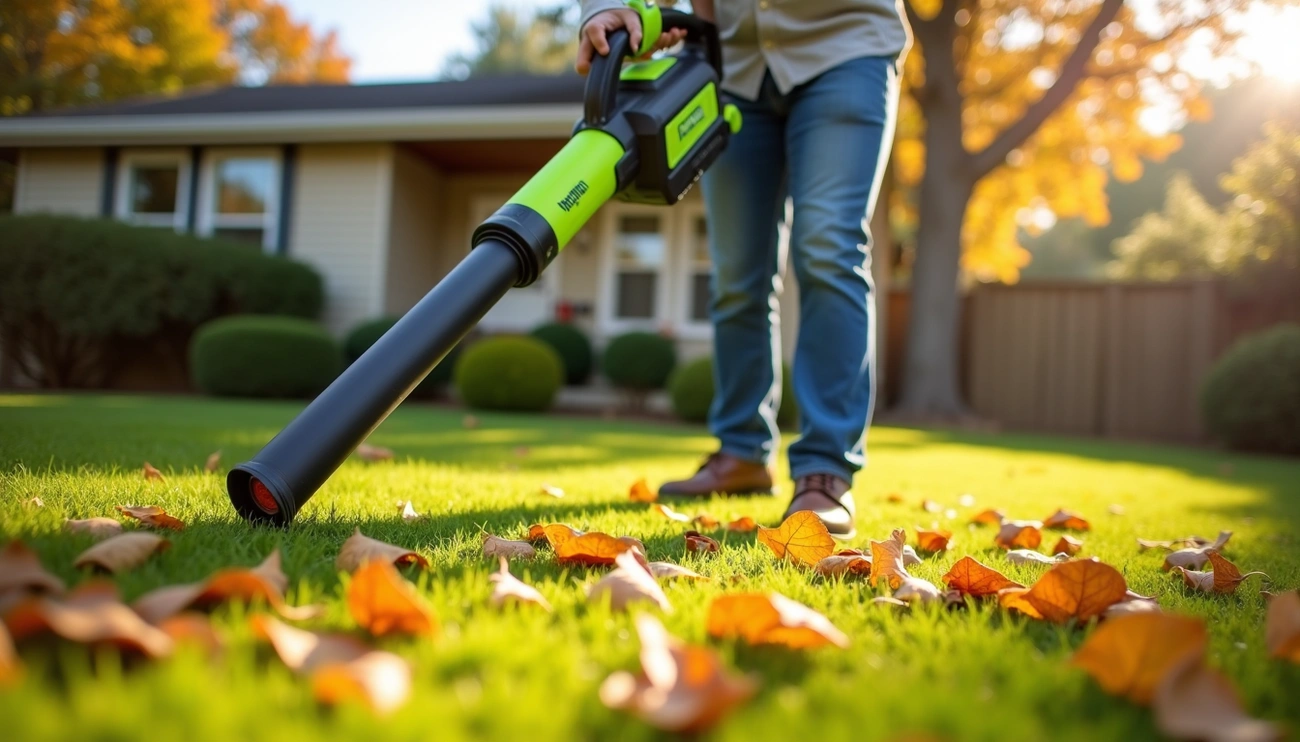
Yes, a battery leaf blower can move leaves on grass. Cordless models effectively clear dry or lightly damp leaves and grass clippings, especially units with high CFM and MPH ratings. Performance drops with thick, wet piles, but modern battery blowers can rival gas models when used correctly.
Why Use a Battery Leaf Blower on Grass?
Switching to a battery-powered leaf blower for yard maintenance offers several distinct advantages over traditional options. I’ve found these cordless tools increasingly capable of handling grass-based leaf removal while providing significant benefits for both users and the environment.
Portability and ease of use
The lightweight design of battery leaf blowers makes them exceptionally easy to handle when clearing leaves from grassy areas. Most battery models weigh significantly less than their gas counterparts, with some electric trimmers weighing less than half of comparable gasoline-powered options. This reduced weight translates to easier maneuvering around your lawn and less strain on your arms and back during extended use.
I particularly appreciate how battery grass blowers eliminate the need to drag cords across your lawn or manage heavy equipment. Their ergonomic designs often include rubber handle inserts for a comfortable grip, allowing for precise control when directing airflow across grass surfaces. Additionally, manufacturers have optimized these tools for balance, making them ideal for reaching under bushes or working along lawn edges where leaves often accumulate.
Quieter and eco-friendly operation
One compelling reason to use a battery leaf blower on grass is the dramatically reduced noise level. While gas blowers typically produce more than 100 decibels of noise, electric models operate at approximately 80 decibels. In fact, the quietest electric blower is about one-fourth as loud as the loudest gasoline model. This noise reduction is particularly valuable in residential neighborhoods where disturbing neighbors is a concern.
The environmental benefits extend beyond noise pollution. Battery-powered garden blowers produce zero direct emissions, helping reduce the carbon footprint of your lawn maintenance routine. This matters considerably since the Environmental Protection Agency reports that gas-powered outdoor garden equipment accounts for approximately 5% of air pollution in the United States. Moreover, these eco-friendly tools help eliminate emissions that can worsen respiratory conditions like asthma, contributing to improved air quality.
No cords or fuel needed
Perhaps the most practical advantage of using a battery leaf blower on grass is the freedom from cords and fuel. Unlike corded electric models that limit your range, or gas blowers that require fuel mixing and regular maintenance, battery blowers offer unrestricted movement across your entire yard. This mobility is particularly valuable when working around landscape features or following the natural contours of your lawn.
I’ve discovered that modern battery technology has eliminated many previous limitations. Today’s lithium-ion batteries provide consistent power output until depleted, with some models delivering up to 90 minutes of runtime. For larger properties, the ability to swap batteries means continuous operation is entirely possible – simply use a spare battery while the first one charges.
The maintenance simplicity cannot be overstated. Battery leaf blowers don’t require:
- Oil changes
- Air filter replacements
- Spark plug maintenance
- Fuel mixing or storage
Consequently, you’ll spend more time actually clearing leaves from your grass and less time servicing your equipment. This convenience, paired with the long-term cost savings on fuel and maintenance parts, makes battery grass blowers an increasingly practical choice for effective lawn care.
Does a Leaf Blower Work on Grass?
Many homeowners wonder about the effectiveness of leaf blowers on grassy surfaces. The short answer is yes, a battery leaf blower can indeed move leaves on grass—although not always with the same efficiency as on hard surfaces.
How grass affects airflow
The structure of grass creates a natural barrier that affects how air from your yard blower interacts with fallen leaves. Unlike hard surfaces where air can easily slide underneath leaves to lift and move them, grass creates friction and resistance. The longer your grass, the more it interferes with the airflow from your garden blower.
When using a grass blower, you’ll notice that leaves sitting on top of short, dense turf are relatively easy to move. Nevertheless, those that have settled deeper into the grass blades require more focused airflow to dislodge. This happens because grass blades absorb and deflect some of the air pressure that would otherwise lift the leaves.
What makes this challenging is that leaves on grass often form a sort of interlocking layer, especially after rainfall or morning dew has caused them to stick together. Instead of gliding effortlessly across a flat surface, the air from your blower must penetrate through the grass to get beneath these matted layers.
When it works well and when it doesn’t
Battery leaf blowers perform best on grass under specific conditions. First, they excel when dealing with dry leaves, grass clippings, and thin twigs. The moisture content of both the leaves and the grass itself plays a crucial role in determining effectiveness.
A leaf blower works efficiently on grass when:
- The leaves are dry and light
- The grass is relatively short and dry
- You’re working with a moderate volume of leaves
- Weather conditions are calm with minimal wind
On the contrary, leaf blowers struggle when attempting to move wet leaves off grass. The combination of moisture and the textured surface creates too much resistance for most battery-powered models to overcome effectively. Additionally, if leaves have been compacted by foot traffic or have partially decomposed into the turf, even powerful blowers might not provide satisfactory results.
Regarding grass maintenance specifically, leaf blowers can successfully remove grass clippings and help dislodge or break up matted grass. This makes them versatile tools for general lawn care beyond just autumn leaf removal.
Tips for improving effectiveness
To maximize the effectiveness of your battery leaf blower on grass, consider these practical approaches:
First, timing matters significantly. Try to tackle leaf removal when conditions are dry—preferably after morning dew has evaporated but before afternoon winds pick up. Dry leaves are substantially easier to move with a blower than wet ones.
Second, adjust your technique based on the leaf density. For light accumulations, a steady sweeping motion works well. For heavier leaf cover, concentrate the airflow in a specific area to create a small opening, then gradually widen it by working from the center outward.
Third, consider using your blower at a slight angle rather than pointing it directly at the ground. This creates a more effective “scooping” action that gets underneath leaves resting on grass.
Fourth, recognize that on lawns, leaves move much less easily than those on hard surfaces like driveways or sidewalks. Accordingly, you might need to increase the power setting when transitioning from hard surfaces to grass areas.
Ultimately, while a battery leaf blower can definitely move leaves on grass, it’s important to have realistic expectations about its limitations compared to performance on hard surfaces. By understanding how grass affects airflow and adjusting your approach accordingly, you’ll achieve much better results from your grass blower.
How to Use a Battery Blower on Grass Efficiently
Mastering the right technique makes all the difference when using a battery leaf blower on grass. I’ve discovered that efficiency isn’t just about power—it’s about strategy and proper handling.
Start from the edges and work inward
The most effective approach begins at the perimeter of your yard. Initially, position yourself at the outer edge and methodically work toward the center where you plan to collect the leaves. This prevents you from inadvertently blowing leaves back onto areas you’ve already cleared.
For large lawns, dividing your yard into manageable sections proves much more effective than trying to clear everything at once. By creating smaller work zones, I can maintain better control and avoid scattering leaves haphazardly across my lawn. This systematic approach essentially lets me “squeegee” my entire property, directing debris to a designated collection point.
Use sweeping motions to form rows
The proper technique involves consistent side-to-side sweeping motions as you move across the area. This creates what professionals call “windrows”—long rows of leaves that are much easier to gather later. I make sure to slightly overlap each path to avoid missing spots.
When using this technique, holding the blower at the correct angle is crucial. I keep the nozzle angled slightly downward toward the ground. This concentrated airflow provides more precision and control, making it easier to move leaves across grass. As the leaves accumulate into rows, I can then focus on directing these rows into central collection piles.
Avoid blowing against the wind
Working with nature yields better results than fighting against it. Primarily, I check wind direction before starting and position myself so the wind is at my back whenever possible. This simple step prevents the wind from undoing my work and helps direct leaves where I want them to go.
Besides saving effort, this technique preserves battery life—a key consideration with cordless blowers. When the wind assists your blowing direction, you’ll need less power to move the same volume of leaves, extending your runtime.
Use lower speeds near flower beds
Adjusting your blower’s airflow settings based on the specific area is vital for efficiency. For delicate zones like flower beds or areas with mulch, I always switch to lower speed settings. This prevents unwanted disturbance of plants or decorative materials while still effectively removing leaves.
Conversely, open lawn areas benefit from higher speeds, which move leaves more quickly across grass surfaces. This strategic speed management not only protects your landscaping but also optimizes battery usage, allowing me to complete more work on a single charge. Through proper speed control, I maintain precision while maximizing the effectiveness of my battery leaf blower on grass.
Common Mistakes to Avoid
Even with the best battery-powered equipment, leaf blowing on grass can go wrong without proper preparation and technique. Understanding these common pitfalls will help extend your battery life and improve your clearing efficiency.
Using the wrong nozzle or speed
The nozzle shape significantly impacts your grass blower’s effectiveness. Flat nozzles concentrate air pressure, making them ideal for stubborn leaves on hard surfaces, whereas round nozzles deliver broader airflow, better suited for open lawn areas. Switching between nozzle types gives you better control when adapting to different areas of your yard.
Speed control is equally important. Light, dry leaves require lower speeds to guide them gently into piles without scattering them across your entire lawn. For heavier or damp materials, gradually increase power to lift compacted debris efficiently. Despite what many believe, constantly running at maximum power wastes battery life and often reduces effectiveness rather than improving it.
To properly control your garden blower, start with the nozzle close to the ground, then raise it to a height that doesn’t generate dust. Practice different nozzle movement and throttle control combinations to find what works best for your specific lawn conditions.
Trying to blow wet leaves
First thing to remember about leaf blowing: dry weather is always best. Wet leaves become substantially heavier, clump together, and stubbornly stick to surfaces. Unless absolutely necessary, avoid using your yard blower after rain or morning dew.
Wet leaves not only drain battery power faster but can become a slip hazard if moved to walkways. If leaves are soaked, it’s generally better to wait until they’ve had time to dry rather than fighting a losing battle with your battery blower.
Not checking battery level before starting
Regardless of your task size, always verify your battery charge before beginning. For battery-powered blowers, fully charge both the primary battery and any spares before starting. This simple step prevents the frustration of interrupted work.
For longer sessions, consider whether your battery provides enough runtime for your entire yard. Preparation is key—have a charging station ready and, if possible, a backup battery to swap when needed. Ultimately, properly managing your power supply ensures you’ll complete the job without unexpected downtime.
What to Look for in a Grass Blower
Selecting the right battery leaf blower makes all the difference when clearing leaves from grass. Understanding key specifications will help you find the perfect tool for your lawn.
High air volume (CFM) and speed (MPH)
These two measurements determine your blower’s power. CFM (cubic feet per minute) indicates how much air volume the blower moves—higher numbers mean more leaves moved simultaneously. MPH (miles per hour) measures airspeed—crucial for lifting heavier or wet debris.
For effective grass clearing, look for 400+ CFM and 150-190 MPH. Remember, higher CFM helps move larger volumes of leaves, primarily benefiting those with expansive lawns.
Comfortable grip and lightweight design
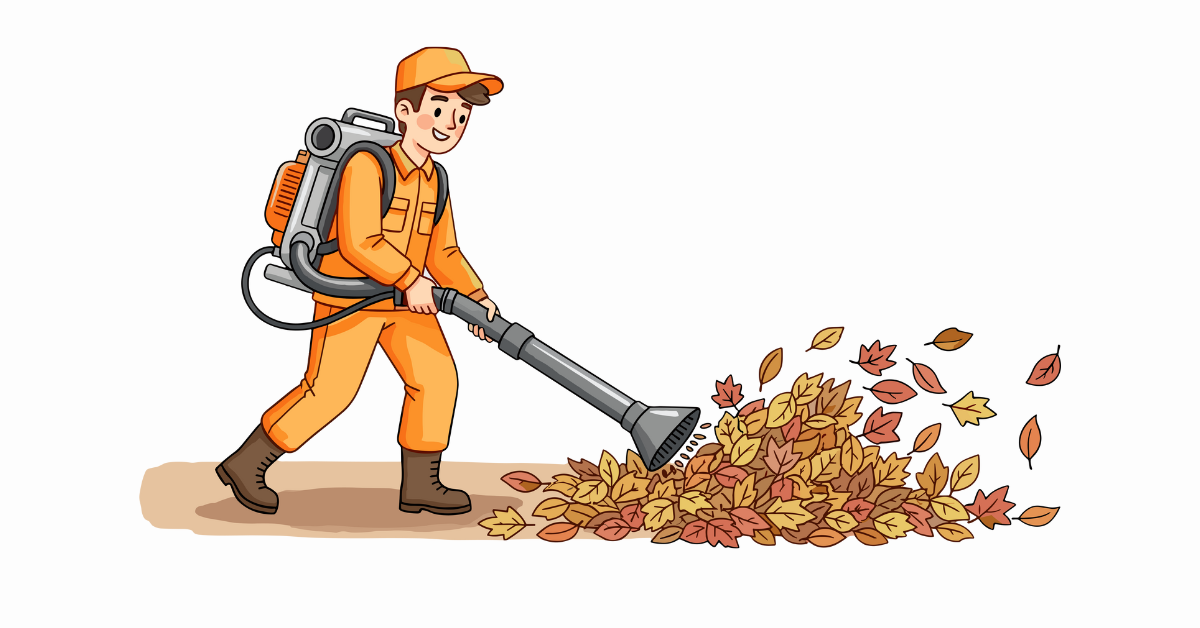
The physical design impacts your comfort during extended use. Seek models with ergonomic handles featuring rubber inserts for stable gripping. Backpack models distribute weight effectively through padded straps, reducing strain on your arms.
Weight varies by style—handheld blowers typically weigh 5-10 pounds, whereas backpack versions range from 15-20 pounds.
Battery runtime and charging time
Most battery-powered models provide 20-30 minutes of operation per charge, though premium options reach up to 90 minutes. For larger yards, consider investing in spare batteries to avoid interruptions.
Noise level and local regulations
Battery blowers operate around 80 decibels—substantially quieter than gas models exceeding 100dB. Beyond personal comfort, this matters legally, as numerous communities enforce strict noise limitations on yard equipment.
Conclusion
Battery leaf blowers certainly prove effective for moving leaves on grass, though they work best under specific conditions. Dry leaves on short grass yield the most satisfactory results, while wet or matted leaves present greater challenges. Throughout my experience with these tools, I’ve found their advantages extend far beyond basic functionality.
The eco-friendly nature of battery-powered blowers makes them an excellent alternative to gas models. They produce zero emissions, create significantly less noise, and free users from the hassles of fuel mixing and cord management. Additionally, their lightweight design reduces physical strain during extended yard work sessions.