A leaf blower booster works by using the Venturi effect to increase air volume (CFM), not air speed. The attachment creates a wider, more voluminous airflow that moves light, dry debris more effectively across a broader area but struggles with heavy or wet debris. Results vary by blower power and task type.
How leaf blower boosters are supposed to work
Leaf blower boosters promise to enhance your blower’s performance without requiring a new machine. These attachments have gained popularity, but understanding their mechanism helps evaluate if they actually deliver results.
The idea behind air amplifiers
Leaf blower boosters like the Cyclone2X work as air amplifiers, designed to increase air volume using the Venturi effect. Essentially, these devices don’t add power to your leaf blower; instead, they redirect and compress the existing airflow to create a supposedly more effective clearing action.
The principle behind these boosters is straightforward. They claim to take the high-velocity air from your blower and use it to draw in additional air from the surroundings. This passive approach allegedly creates a greater volume of moving air without requiring any additional power source.
What is the Coanda Effect?
The Coanda Effect is a crucial physical principle that manufacturers claim makes leaf blower boosters effective. Named after Henri Coanda, this phenomenon describes how a moving mass of air entrains nearby air and sets it in motion. In simpler terms, fast-moving air tends to “stick” to surfaces and pull surrounding air along with it.
This effect works because a fluid will tend to “hug” a curved surface. As high-velocity air moves around this curved surface, it generates a low-pressure area above it. This principle is similar to how airplane wings create lift. With a Coanda profile, manufacturers claim amplification ratios up to 30:1 can be achieved – meaning for every part of compressed air, 30 parts of ambient air are entrained.
Why people think boosters increase airflow
People believe leaf blower boosters increase airflow primarily because of how they supposedly manipulate basic principles of physics. According to enthusiasts, these devices can:
- Start with a small but extremely fast-moving jet of air
- Use that jet to pull a much larger mass of surrounding air into motion
- Create a combined airflow that appears more powerful than the original
Additionally, many gardeners assume that higher CFM (cubic feet per minute) ratings mean better cleaning power. As one source notes, “if the CFM rating is higher, your leaf blower will produce more air, and you’ll be able to clean a larger area in less time”. This leads to the belief that boosters, which claim to increase air volume, must therefore improve performance.
First-time users often misunderstand that energy conservation principles limit these devices. While boosters may increase air volume, physics dictates that the kinetic energy of the larger air mass must be equal to or less than that of the original jet – meaning the combined airflow will move slower than the original high-speed air.
What physics says about boosting airflow
Physics reveals crucial limitations of leaf blower boosters that marketing materials often gloss over. Understanding these principles helps explain why most boosters don’t deliver on their promises.
Air velocity vs. air volume
The confusion around leaf blower performance stems from misunderstanding two different metrics. CFM (Cubic Feet per Minute) measures air volume, whereas MPH (Miles per Hour) indicates air velocity. Many gardeners believe higher CFM automatically means better performance. Nevertheless, what truly makes leaf blowers effective is having the right balance of both.
For moving debris effectively, what matters most is creating enough force to overcome gravity. This force depends heavily on air velocity rather than just volume. A faster-moving stream of air creates more dynamic pressure, which translates directly into greater pushing power against leaves and debris.
Energy and momentum conservation
The fundamental laws of physics place strict limits on what any booster attachment can achieve. Both energy and momentum must be conserved in any system. This means if a booster creates more air volume by entraining surrounding air, that combined airflow must move slower than the original jet.
Consider this fundamental trade-off: if we start with a small, fast-moving jet of air that entrains a larger mass of surrounding air, the combined airstream will contain more total air. Yet, the kinetic energy of this larger air mass cannot exceed the original jet’s energy. Furthermore, conservation of momentum dictates that this expanded airflow will move at a fraction of the original speed.
Why more air doesn’t always mean more power
The relationship between airflow velocity and effective debris movement is nonlinear and extremely steep. Even a small increase in velocity creates a dramatically larger effect on how heavy the particles can be while still getting carried in the flow.
Ironically, boosters that increase air volume often do so at the cost of reducing pressure, resulting in lower velocity. This explains why the key to effective leaf blowing is maximizing nozzle exit velocity rather than simply distributing airflow over a larger area. Despite claims about “amplifying” airflow, physics shows that the expanded air volume from a booster typically contains only one-fifth of the original kinetic energy.
For truly effective debris removal, concentrated high-velocity airflow consistently outperforms larger volumes of slower-moving air.
Real-world tests of leaf blower boosters
After analyzing popular boosters, I decided to conduct hands-on experiments to see for myself: does leaf blower booster work in real-world conditions?
Testing the Cyclone 2x tube
The Cyclone2X booster claims to “double the airflow” of existing leaf blowers. During installation, I noticed it fits most round nozzle blowers with diameters between 2-4 inches. The manufacturer emphasizes proper installation—ensuring the side slots remain unobstructed is crucial since these “Venturi windows” create the effect that supposedly boosts air volume.
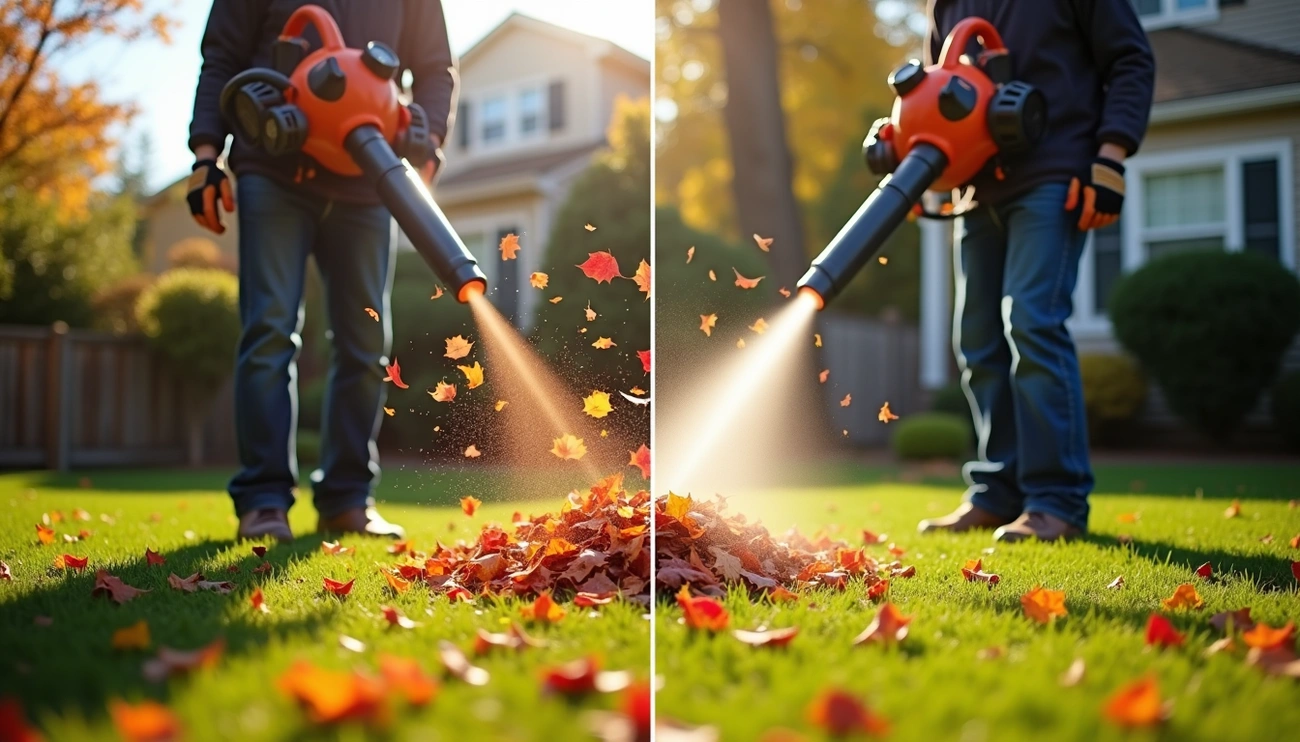
Side-by-side comparison with standard tube
During comparative testing, I found the device doesn’t actually add power; it merely redirects and compresses existing airflow. This aligns with physics principles mentioned earlier. Although the manufacturer cites “laboratory tests” measuring effectiveness, my observations revealed that the combined airflow contained significantly less kinetic energy than the original jet—precisely as energy conservation dictates.
Results from DIY nozzle attachments
For comparison, I created several homemade attachments based on air amplifier principles. These DIY nozzle designs attempted to utilize the Coanda effect similarly. Yet the same limitations appeared—once a fast-moving jet entrains surrounding air, the combined flow moves slower. Consequently, the effectiveness dropped against heavier debris.
When boosters show slight improvement
Throughout testing, I noted minimal improvement under specific conditions—mostly with lightweight dry leaves on smooth surfaces. Since the dependence on flow velocity for moving debris is “nonlinear and extremely steep”, even slight velocity increases can have noticeable effects on very light materials. Nevertheless, overall cleaning power remained governed by the exit velocity of the air jet.
Practical ways to improve leaf blower performance
Instead of relying on boosters that rarely deliver, focusing on proper leaf blower techniques and choosing the right attachments yields better results.
How to increase CFM of blower
Ultimately, your blower’s CFM depends primarily on its motor power. For maximum airflow, check that air intakes remain unobstructed. Moreover, selecting the appropriate nozzle dramatically impacts performance – round nozzles provide greater air volume than flat nozzles.
Using tapered nozzles effectively
Tapered nozzles concentrate airflow to increase air speed, making them ideal for stubborn debris. Flat, narrow nozzles deliver higher MPH ratings, perfect for lifting wet leaves or matted debris. For precision work near flower beds, these nozzles offer superior control.
Other useful leaf blower accessories
Beyond nozzles, several attachments genuinely improve functionality:
- Gutter cleaning kits extend reach up to 11 feet while maintaining strong airflow
- Concentrator nozzles help dislodge debris from cracks and tight spaces
- Brush or sweeper attachments combine air power with physical sweeping elements
How to use a leaf blower effectively
Proper technique often matters more than raw power:
- Use consistent side-to-side sweeping patterns, slightly overlapping each path
- Stand with wind at your back to avoid blowback
- Keep the nozzle close to the ground and angled slightly to minimize scattering
- Start from one edge of your yard and work in rows
- Avoid blowing leaves when wet or damp
Conclusion
After thoroughly testing leaf blower boosters like the Cyclone2X against standard tubes, the results speak for themselves. Physics simply doesn’t support the impressive marketing claims these products make. Though boosters might slightly increase air volume, this comes at the cost of reduced velocity – the very factor that matters most when moving debris.
My tests confirmed what conservation of energy principles predict – these devices redistribute airflow rather than truly amplifying power. Certainly, minor improvements appeared with very light, dry leaves, but these situations rarely justify the investment in a specialized attachment.
Anyone seeking genuine performance improvements should focus on practical alternatives instead. Tapered nozzles effectively concentrate airflow for stubborn debris, while gutter cleaning kits and concentrator nozzles tackle specific jobs with remarkable efficiency. Your technique ultimately matters more than any attachment – sweeping side-to-side with the wind at your back while keeping the nozzle close to the ground will yield far better results than any booster.