A Stihl blower dies when you give it gas due to restricted fuel, air, or exhaust flow. Common causes include a clogged carburetor from old fuel, a dirty air filter, a blocked spark arrestor screen, damaged fuel lines, or a faulty spark plug. Check the spark plug and arrestor first, clean the air filter, and use fresh fuel before rebuilding the carburetor.
Check the Spark Arrestor First
If your Stihl blower dies when you give it gas, the spark arrestor should be your first troubleshooting step. This often-overlooked component can become clogged after regular use and dramatically affect performance.
What a spark arrestor does
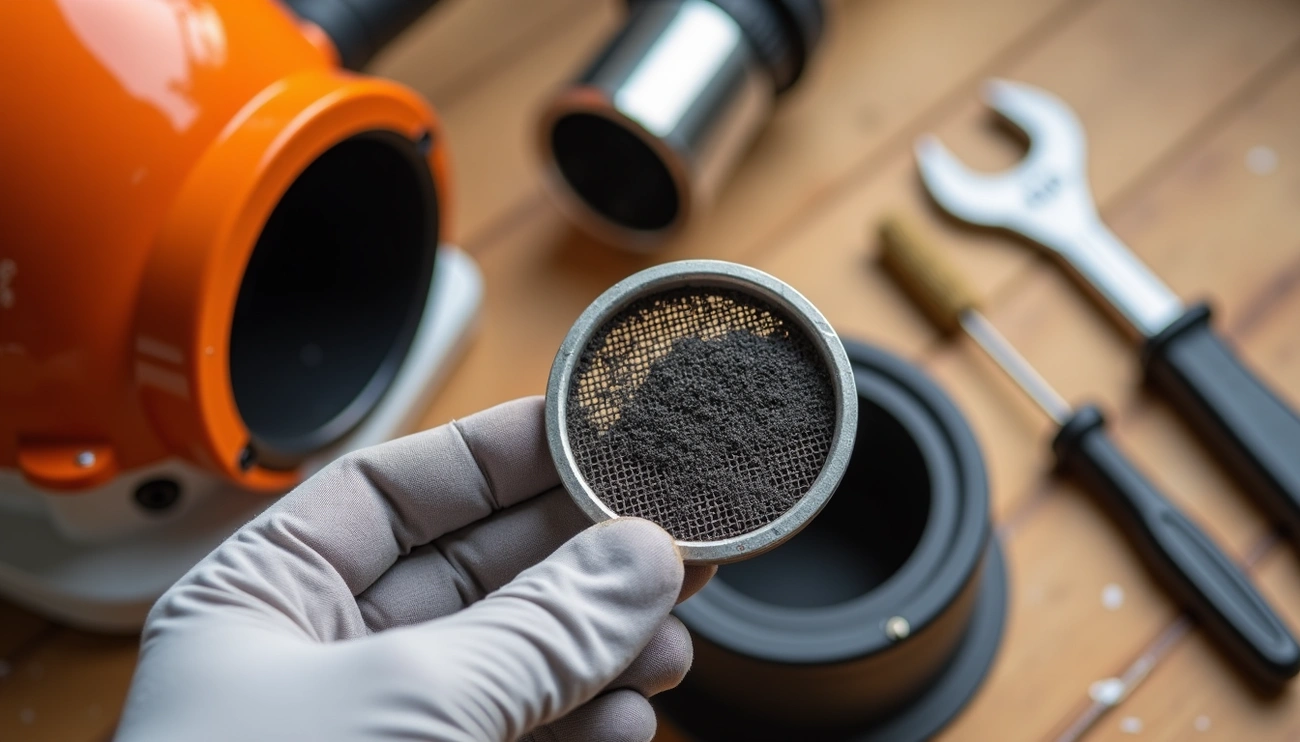
The spark arrestor is a small mesh screen located inside your leaf blower’s muffler that serves a crucial safety function.
It prevents hot carbon particles from exiting through the exhaust system, significantly reducing the risk of accidental fires while operating your equipment.
This is especially important during dry conditions or when working around flammable materials, such as dry leaves and grass.
Although small, this component plays a major role in preventing your leaf blower from stalling when you give it gas.
Over time, carbon deposits build up on the screen, restricting exhaust flow and causing your engine to bog down.
How to inspect it for blockage
Common symptoms that indicate a clogged spark arrestor include:
- Loss of power when accelerating
- The engine bogs down or dies at full throttle.
- Unable to reach maximum RPM
- Excessive smoke from the exhaust
- Blower sounds like “it’s choking to death.”
To inspect the spark arrestor, first locate the muffler on your STIHL blower. Typically, you’ll need to:
- Flip the blower on its side for better access.
- Locate the small bolt or screws on the muffler.
- Loosen (don’t fully remove) these fasteners.
- Remove the exhaust deflector to access the spark arrestor screen.
A clean spark arrestor allows light to pass through. If you can’t see through it, carbon deposits have clogged the fine mesh.
Steps to clean or replace it
Once removed, you have several effective cleaning options:
- Use needle-nose pliers to hold the screen (it gets hot) and burn off carbon deposits with a propane torch.
- Soak in carburetor cleaner for several hours, then blow with compressed air.
- Scrub with a wire brush and rinse with parts cleaner.
For stubborn deposits, oven cleaner works particularly well for removing carbon buildup. After cleaning, the screen should appear noticeably clearer with visible openings in the mesh.
Although cleaning is effective, replacement is inexpensive (around $2) and might be preferable if you’re experiencing recurring issues.
Remember that removing it entirely may temporarily improve performance, but it creates a serious fire hazard and might be illegal in your area, particularly in California.
Inspect the Carburetor and Fuel Lines
After checking the spark arrestor, your Stihl blower may still die when you give it gas. The next critical area to examine is the carburetor and fuel lines, which together form the heart of your blower’s fuel system.
Signs of a clogged carburetor
A clogged carburetor typically manifests in several telltale symptoms. Your Stihl blower might:
- Run roughly or unevenly.
- Struggle and die when accelerating.
- Start but stall after 10 seconds.
- Need partial choking to maintain power.
- Fail to idle properly.
These issues occur because the carburetor’s small passages become restricted, preventing a proper fuel-air mixture at higher throttle positions.
How old fuel causes buildup
Fuel deterioration begins remarkably quickly—sometimes within 15 days and certainly after three months. As gasoline sits in your blower, several problematic changes occur:
Firstly, volatile components evaporate, leaving behind sticky substances that resemble varnish or tiny rust-like flakes. Additionally, ethanol in modern fuels attracts moisture from the air, forming water that settles at the bottom of tanks, where it can corrode metal components.
This combination of varnish buildup and water contamination prevents proper fuel flow through the carburetor’s tiny passages. Moreover, as fuel ages, it becomes increasingly acidic, damaging rubber components throughout the fuel system.
Cleaning vs. rebuilding the carburetor
For light carburetor clogging, cleaning with carburetor cleaner might suffice. This process involves:
- Removing the carburetor from the engine
- Disassembling while noting screw settings
- Cleaning with carburetor cleaner and compressed air
- Washing metal parts with warm, soapy water
- Drying thoroughly before reassembly
Nevertheless, if serious varnish buildup occurs or cleaning proves ineffective, rebuilding with a complete carburetor kit becomes necessary. Sometimes, replacing the entire carburetor proves more cost-effective than rebuilding.
When to replace fuel lines
Fuel lines deteriorate predictably with exposure to ethanol. They typically become:
- Swollen and gooey
- Discoloured or soft
- Prone to cracking or leaking
Stihl reformulated their fuel line materials three years ago, substantially improving durability. Yet even with improvements, regular inspection remains essential since internal deterioration can send rubber particles into the carburetor, creating new blockages.
For maximum reliability, replace fuel lines whenever cleaning or rebuilding the carburetor. Furthermore, yellow “tygon” fuel line material offers superior ethanol resistance compared to standard lines.
Replace or Clean Filters
Clogged filters are another common reason your Stihl blower dies when accelerating. Let’s examine these often-neglected maintenance items that can make a world of difference.
Air filter and its role in airflow
The air filter, typically located on the side or rear of your blower, prevents dust and debris from entering the engine.
When clogged, your engine receives too much fuel yet insufficient air, causing rough running and stalling at full throttle.
For extremely dusty environments, Stihl offers special orange foam oil-impregnated filters that provide enhanced protection.
Fuel filter and how it gets clogged
At the end of the pickup hose in your gas tank sits the fuel filter.
This component screens out dirt and rust particles that would otherwise damage your engine.
Over time, ingredients in fuel evaporate, leaving behind a sticky substance that clogs this filter.
Subsequently, your blower may bog down or completely shut off when you accelerate.
How to replace both filters safely
For the air filter:
- Turn the filter cover lock counterclockwise.
- Remove the filter cover and clean the surrounding area.
- Install a new filter in the same orientation as the old one.
For the fuel filter:
- Create a wire hook to fish out the fuel line.
- Carefully remove the old filter without stretching the line.
- Attach a new filter and return it to the tank.
Replacing both filters annually is excellent preventive maintenance and often resolves performance issues immediately.
Other Common Fixes to Try
Beyond filters and carburetors, several other issues could cause your Stihl blower to die at full throttle. These quick fixes often solve the problem without major repairs.
Check the fuel cap vent.
The fuel cap contains small vent holes that allow air into the tank as fuel is consumed.
Throughout operation, these vents can become clogged, creating a vacuum that prevents fuel flow.
Symptoms include a blower that runs fine initially but gradually loses power. To test this, slightly loosen the cap while running – if performance improves immediately, you’ve found your culprit.
Use fresh fuel with the correct mix.
Gasoline begins deteriorating in as little as 30 days. For optimal performance, mix:
- 50:1 ratio (20ml oil per litre of petrol) with Stihl oil
- 25:1 ratio if using other brands
- Minimum 89 octane fuel
Essentially, avoid storing mixed fuel for more than 30 days unless using specialized products like STIHL MotoMix, which remains stable for up to 2 years.
Avoid discount gas stations.
Lower-quality fuels often contain higher ethanol content or contaminants that damage small engines. According to experts, fuel quality varies significantly between stations.
When to use a fuel stabilizer
Add a stabilizer whenever fuel might sit unused for more than 2 months. Double-dosing provides better protection for seasonal equipment.
Before winter storage, running stabilized fuel through the engine helps protect internal components.
How to test if the choke is working
A malfunctioning choke prevents proper starting and running. To test it:
- Verify the choke lever moves freely.
- Try starting with starting fluid as a troubleshooting tool.
- Check for flooding symptoms (fuel smell, wet spark plug)
Conclusion
Dealing with a Stihl blower that dies when you give it gas certainly tests your patience. Throughout this guide, we explored several common culprits behind this frustrating issue. Most importantly, regular maintenance of the spark arrestor prevents carbon buildup that chokes your engine during acceleration.
Additionally, fuel-related problems remain the leading cause of performance issues. Old gasoline creates varnish that clogs carburetors and fuel lines within just 30 days. Therefore, using fresh fuel with the correct oil mix ratio significantly reduces these problems.
Clogged filters likewise starve your engine of either air or fuel when you need power most. Replacing both air and fuel filters annually serves as excellent preventive maintenance that often resolves performance issues immediately.