Husqvarna leaf blowers are made in multiple countries. Many consumer models are manufactured in China, while Husqvarna designs products in Sweden and produces some equipment and components in the United States. This global manufacturing approach balances cost efficiency with engineering standards.
Where is Husqvarna manufactured?
Husqvarna’s global manufacturing network spans multiple continents, with strategic production centers positioned to serve regional markets effectively.
Overview of Husqvarna Group
Founded in 1689, Husqvarna Group has evolved into a global powerhouse in outdoor power equipment manufacturing. Headquartered in Stockholm, Sweden, the company operates under a structure that includes several divisions, most notably Husqvarna Forest & Garden, Gardena, and Husqvarna Construction.
With net sales reaching SEK 53.3 billion in 2023, the company demonstrates significant market presence. The Group employs approximately 13,800 workers globally across 40 countries, creating an extensive network that supports its diverse product portfolio.
Key manufacturing countries
Husqvarna maintains an impressive 30 production sites across 13 countries, strategically positioned to optimize manufacturing efficiency and market accessibility. Major production facilities are located in:
- Sweden: Home to flagship manufacturing operations in Huskvarna, where premium components like X-Cut® chainsaw chains are produced
- Europe: Major plants in Germany, England, Poland, and the Czech Republic
- North America: Manufacturing in Orangeburg, South Carolina, which produces wheeled products and assembles handheld products for the North American market
- Asia: Production facilities in China (Changzhou, Xiamen, Shijiazhuang, and Hebei) and India (Nashik)
- South America: Operations in Brazil supporting Latin American markets
How global operations support local markets
This distributed manufacturing approach allows Husqvarna to respond efficiently to regional market needs. North America represents Husqvarna’s largest market, accounting for approximately one-third of the company’s total sales.
The strategic partnership announced with Flex Ltd. in 2024, involving the divestment of manufacturing operations in Orangeburg, aims to increase profitability while maintaining production continuity through a long-term supply agreement.
Throughout the company’s global footprint, manufacturing facilities are tailored to regional strengths and requirements. For instance, European plants often focus on premium products and innovation, while Asian facilities may emphasize cost-optimized entry-level products.
Husqvarna leaf blower production facilities
For leaf blower enthusiasts and professionals alike, knowing where their equipment comes from matters. Husqvarna’s dedicated leaf blower production is carried out at several strategic locations across its global manufacturing network.
Main production sites for leaf blowers
Husqvarna manufactures its leaf blowers at select facilities designed for optimal production efficiency. One notable production site is in Nashville, Arkansas, USA, where Husqvarna makes its own engines and blowers.
This facility also produces PoulanPro® branded equipment, which falls under the Husqvarna Group umbrella. Additionally, the company maintains production capabilities for handheld equipment across several of its global facilities to efficiently serve regional markets.
Is Husqvarna made in the USA?
The question of American manufacturing requires some nuance. Many Husqvarna products bear the label “Assembled in the US” rather than “Made in the USA”.
According to US labelling laws, products labelled “Made in the USA” must be “all or virtually all” made in the United States. Husqvarna’s approach reflects the reality of global supply chains—components may originate from various countries before final assembly in American facilities.
When customers inquire about the country of origin, Husqvarna representatives have noted that “no product is made 100% anywhere anymore”, highlighting the company’s integrated global production strategy.
Factory spotlight: Orangeburg, South Carolina
The Orangeburg facility is Husqvarna’s flagship North American operation, boasting 1.9 million square feet of manufacturing space. This plant primarily focuses on wheeled products, such as tractors and zero-turn mowers, and also assembles handheld products for the North American market.
In early 2024, Husqvarna announced a strategic partnership with Flex Ltd., divesting its Orangeburg manufacturing operations while maintaining production continuity through a long-term supply agreement. Under this arrangement, Flex manufactures Husqvarna’s products at the facility, and the current workforce is offered employment with Flex.
Before this transition, the Orangeburg plant employed approximately 2,200 workers during peak production, of whom about 70% were considered core employees. The facility has undergone significant investment, with Husqvarna committing over $100 million in expansion projects through 2024.
How Husqvarna compares to other brands
When comparing power equipment brands, manufacturing origin often indicates quality and performance expectations. Husqvarna stands alongside industry giants like STIHL and Echo, each brand taking a different approach to production.
Comparison with Stihl and Echo
In head-to-head comparisons between top backpack blowers, the Husqvarna 580BTS offers distinct advantages over competitors. Many users prefer its side-mounted handle design compared to Stihl’s top-mounted approach on models like the BR 600 and BR 700. Furthermore, the Husqvarna model receives praise for its fuel capacity and impressive power output.
Nevertheless, Stihl blowers generally earn higher marks for comfort during extended use. The Stihl models feature more convenient tube adjustment, allowing users to slide components in and out easily after unlocking.
It’s worth noting that Husqvarna and RedMax blowers are essentially identical products with different branding since Husqvarna manufactures RedMax.
Where are Husqvarna chainsaws made?
Husqvarna chainsaws are manufactured in several countries, depending on their market positioning. Premium models typically have their power heads (the core component) manufactured in Sweden before being shipped to American facilities for final assembly with locally produced components, such as Oregon bars.
Entry-level and budget-friendly models are predominantly manufactured at Husqvarna’s six Chinese plants. Meanwhile, some production occurs in Brazil and additional US facilities. The company maintains a substantial manufacturing center in Nashville, Arkansas, spanning 874,000 square feet, where chainsaws and trimmers are produced alongside warehousing operations.
Global vs local manufacturing strategies
Husqvarna’s manufacturing approach blends Swedish tradition with regional specialization. Despite representing only 40% of global sales, US facilities produce 54% of Husqvarna’s total output—highlighting their export significance.
This strategic placement of manufacturing resources enables Husqvarna to match product quality tiers with appropriate production locations. Swedish and US-made products generally target professional users seeking maximum durability, whereas Chinese-manufactured items serve entry-level consumers prioritizing value. Regardless of origin, all products maintain Husqvarna’s baseline quality standards.
Innovation and sustainability in Husqvarna manufacturing
Behind every Husqvarna product lies a commitment to innovation and sustainability that shapes how these powerful tools come to life.
Use of robotics and automation
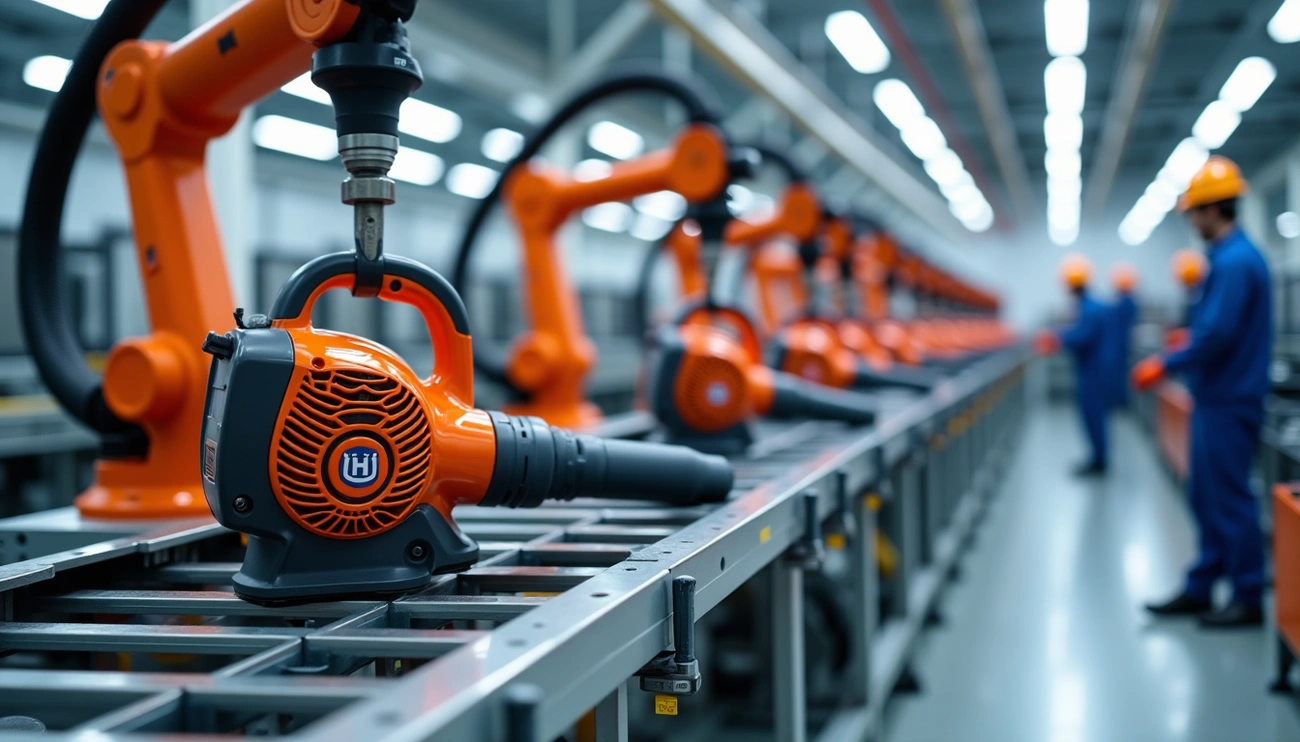
Husqvarna has pioneered robotics for over 30 years, positioning itself as a leader in this technology. Their manufacturing facilities incorporate significant automation, with approximately 40% of production processes automated for certain product lines.
Uniquely, the company optimizes product preparation through 3P workshops, where operations personnel directly influence robotic product design to enable more efficient production.
Eco-friendly production practices
Through their Sustainovate framework, Husqvarna actively pursues sustainability across manufacturing operations. The company has set ambitious goals to:
- Cut carbon emissions by 35% across their value chain between 2015 and 2025
- Introduce 50 circular innovations by 2025, with 20 already launched as of mid-2023
Moreover, Husqvarna repurposes equipment from assembly lines reaching the end of their lifecycle, applying a modular line concept that enhances resource efficiency.
Focus on ergonomic and low-noise designs.
The 120iB leaf blower exemplifies Husqvarna’s ergonomic philosophy with its comfortable handle and balanced structure to reduce strain during extended use. Subsequently, the company prioritizes noise reduction, making their products suitable for noise-sensitive environments.
After-sales support and parts availability.
Husqvarna supports product longevity by offering thousands of spare parts for both current and discontinued models. This approach enables customers to repair and extend product life through comprehensive guidance and resources.
Conclusion
Husqvarna leaf blowers are products of a truly global manufacturing network spanning 30 production sites across 13 countries. Throughout this exploration, we have seen how this Swedish company balances international production with strategic regional manufacturing.
Nashville, Arkansas, has emerged as a key facility for leaf blower production in the United States, though many products carry the “Assembled in USA” designation rather than the “Made in USA” designation due to global supply chains.
Additionally, the Orangeburg, South Carolina, facility represents Husqvarna’s commitment to American manufacturing, despite recent partnerships with Flex Ltd. that have changed operational structures while maintaining production continuity. This approach allows Husqvarna to serve North America effectively, its largest market representing approximately one-third of total sales.